


Category: IT

What are the main pain points of systems integration in industry and how to solve them?

pains industrial integration

Digital transformation in industry is increasingly widespread across all business areas, and systems integration is one of the keys to driving this revolution. Industry 4.0 requires a constant exchange of information between systems and devices to optimize production and reduce costs. 

However, many companies still face major challenges when integrating their legacy systems with new technologies.

A lack of efficient integration can result in operational failures, low efficiency, and increased costs. Solutions like iPaaS (Integration Platform as a Service) can help solve these issues by offering fast and hassle-free integration.

In this article, we’ll explore the main pain points that industrial companies face when integrating systems and how solutions like Digibee can help them overcome these challenges.

>>  Book a personalized demo with our team of experts and see how Digibee's iPaaS will bring efficiency to your operation. 

The importance of systems integration in modern industry

Systems integration is the process of connecting different technologies so that they work together harmoniously. In industry, this involves connecting production control systems, ERP (Enterprise Resource Planning), logistics systems (such as WMS) and IoT (Internet of Things) devices, among others.

With digitalization and the rise of Industry 4.0, system integration has become even more crucial. The need for systems that communicate efficiently and in real time has never been greater. For companies, this means better process tracking, greater visibility, increased productivity and reduced human error.

IT systems are no longer isolated compartments and need to connect to a variety of external platforms and devices. In addition, legacy systems need to be integrated with the latest technological advances, such as process automation and the use of data for predictive analytics.

Effective systems integration results in greater control over operations and enables Industry 4.0 companies to adapt quickly to changes, improving competitiveness and reducing costs.

>> Access Digibee's special page on integration for industries

The main pain points of systems integration in industry

While the need for integration is clear, industrial companies often face challenges when trying to integrate disparate systems. Below, we explore the main pain points that companies face when integrating their systems.

1. Production control system

Production control systems are essential for managing factory operations. However, integrating these systems with other systems (such as ERP or logistics systems) can be challenging, especially when there are dependencies on legacy systems. 

Lack of real-time visibility into production data and ineffective communication between different systems can hinder efficiency and cause errors that directly impact production.

2. Engineering systems

Engineering and manufacturing are often interconnected, but the systems that manage both areas are not easily compatible. Companies struggle to integrate engineering systems with manufacturing control systems, resulting in disjointed data and difficulties in making informed decisions. 

This can hamper the ability to quickly adapt production processes to changing demand or technological advances.

3. Logistics and shipping systems (WMS)

Integrating logistics systems such as WMS (Warehouse Management System) with other IT and production systems is often a major challenge. The flow of information between inventory, production and shipping needs to be continuous and accurate. 

If these systems are not properly integrated, problems such as excess inventory, delays and shipping errors can occur, affecting efficiency and costs.

4. Integration with external platforms

In modern industry, many companies rely on external platforms such as suppliers, carriers, and customers to ensure timely and accurate delivery of products. 

Integrating these external systems with the company's internal systems is a complex task, especially when dealing with APIs from different vendors and legacy systems. Lack of effective integration can lead to communication failures, delays and increased operational costs.

These issues can directly affect the productivity, efficiency and competitiveness of companies in the market. The good news is that there are solutions to solve them, so keep reading the post!
pains industrial integration

How Digibee solves these integration pains

Digibee is an iPaaS platform that offers an easy and efficient way to integrate different systems and platforms. With it, companies can overcome the pains of system integration and optimize their industrial operations. 

Let's explore how Digibee solves the mentioned problems.

1. Automation and rapid integration

Digibee makes it easy to integrate legacy systems with new systems and technologies, allowing companies to connect their IT solutions without the need for manual and time-consuming processes. 

The platform offers rapid automation and hassle-free integration, allowing the industry to focus on its operations rather than worrying about complex technical processes.

Count on features like AI-Powered Pair Programmer, who acts as a developer for each person on an IT team by offering proactive integration suggestions, and how Capsule Collections, which are validated reusable components that can be created by any user of the platform.

2. Flexibility and scalability

With Digibee, businesses can integrate a wide range of systems, from ERPs and WMS to IoT devices and external platforms. The platform is highly scalable, allowing businesses to grow without worrying about integration limitations. 

It supports hybrid and multi-cloud architectures, which means Digibee can adapt to the needs of any company, regardless of its technological structure.

You can, for example, make a migration to S/4HANA and accelerate digital transformation with our pre-built SAP integration.

3. Integration between ERP, WMS and engineering systems

Digibee enables ERP, WMS and engineering systems to communicate efficiently, eliminating integration barriers. The platform provides a simple way to connect these systems, streamlining data flows and improving real-time visibility. 

This results in greater control over production, logistics and shipping operations.

4. Reduce costs and increase efficiency

Digibee’s agile integration not only reduces implementation time but also the costs associated with maintaining disconnected systems. The platform helps reduce errors, improve accuracy, and ensure all necessary data is available for informed decision-making. 

This translates into greater operational efficiency, less downtime and reduced costs over time.

Additional benefits of Digibee integration for the industry

In addition to solving integration pain points, Digibee offers a number of additional benefits for industrial companies. 

Some of these benefits include:

  • Increased agility: Rapid, frictionless integration enables companies to adapt their operations more quickly, responding efficiently to changing markets and demands.
  • Data visibility and control: Digibee offers a centralized, real-time view of operations, which improves decision-making and process control.
  • Support and security: With Digibee, businesses have access to ongoing support and a secure platform, ensuring data remains protected and systems operate without interruption.

To see our platform in action for yourself, Take a virtual tour without the need to leave your email or contact details.

Success Stories: How companies in the sector are improving integration

Digibee has helped many companies solve their integration pain points and improve their operations. Examples include companies in the manufacturing, logistics and automation industries that have integrated their systems efficiently, reducing costs and improving productivity.

These companies were able to streamline their operations, improve supply chain control, and ultimately increase operational efficiency by connecting their legacy systems with modern solutions through Digibee.

See some success stories:

Count on Digibee to integrate your systems

Major system integration pain points in industry, such as lack of visibility, disconnected systems, and manual processes, can be overcome with Digibee’s iPaaS. Our platform offers agile and seamless integration, connecting IT systems, ERP, WMS, and IoT devices to optimize industrial operations.

With Digibee, companies not only solve their integration challenges, but also increase efficiency, reduce costs and gain agility to respond to market demands. If you are ready to transform the integration of your industrial operation, experience all the benefits it can offer.

Request a demo and discover how Digibee can transform your systems integration.
Transforming Workflows into Reusable Code Libraries: The Power of Capsules

The need to integrate multiple applications and services has become more urgent than ever. As a result, many organizations have turned to APIs (Application Programming Interfaces) as a way to enable seamless communication between different systems. However, this approach, when applied to internal use cases, can lead to higher costs and limited flexibility.

The challenges of legacy API-led approaches

When it comes to internal reuse, traditional API-based approaches, while effective, can also have some unintended drawbacks. Here are a few examples:

  • Tight coupling: APIs can create tight coupling between applications, making it difficult to evolve or change one application without impacting others. This leads to a cascading level of effort when it comes time to make changes or updates to applications and their dependencies.
  • Redundant coding efforts: When each application has its own API, developers have to duplicate code and effort across multiple projects. While APIs by design are a form of reusability, accessing them still involves writing code to call those APIs, validate data, etc.
  • Unknown reuse opportunities: Without a clear understanding of reuse opportunities, organizations can end up investing in APIs that ultimately don’t serve much purpose. It’s common to end up with an API that exposes hundreds (if not thousands) of functions, but rarely all of those functions are used.
  • Administrative overload: APIs must be secured and managed, requiring ongoing overhead to ensure compliance. When the goal is to expose a function for access by other internal developers, the process is more complex than just writing the API and publishing it.
  • Not suitable for API: Not everything can or should be exposed as an API – direct connections to databases, legacy systems like AS400, or internal customer applications. Developers are then faced with the difficult task of transforming these challenging systems into reusable functions without publishing them as an API.

>>  Book a personalized demo with our team of experts and see how Digibee’s iPaaS will bring efficiency to your business.  

Introducing Capsules, a new way to approach internal reuse

At Digibee, we believe there is a better way. Our innovative approach to internal reuse is based on the concept of “Capsules ” — libraries of reusable code, essentially functions, that can be accessed from any workflow.

The benefits of Capsules

By transforming workflows into reusable code libraries, you can:

Avoid tight coupling

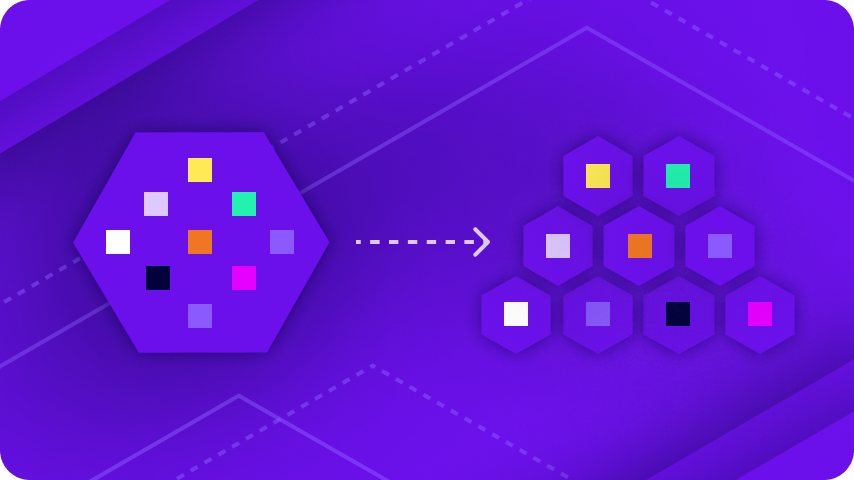
  • Breaking the API Monolith and develop individual functions independently, without the need for the full API lifecycle
  • Remove the risk of problems cascading to downstream dependencies when changes are made 
  • Gain flexibility to publish changes to workflows automatically or explicitly

Eliminate redundant coding efforts

  • Reduce the need for duplicate code and effort across multiple projects
  • Easily drag-and-drop with Capsules as reusable functions, with simple input forms and built-in validation 
  • Eliminate the need for code to call them or check the data they return

Avoid unknown reuse opportunities

  • Use Capsules in any workflow built in Digibee
  • Create useful functions that are valuable in other scenarios and publish them as Capsules for any other developer to access
  • Turn any Capsule into an event-driven microservice or efficiently build APIs from a group of Capsules. Combine the flexibility of Capsules with full API capabilities when needed.

Reduce maintenance overhead

  • Quickly publish and manage reusable functions for other developers to use in workflows within the platform
  • Eliminate the need to manage and distribute API keys
  • Only developers can access Capsules, providing a clear distinction of access

Custom “Connectors”

  • Taking legacy systems like AS400, databases and custom applications and transforming them into functions
  • Avoid the delay of waiting for integration vendors to support niche applications, quickly build your own connectors in the same way you would build an integration flow
  • Create a collection of highly reusable functions specific to your organization/team
  • Tight coupling between applications limits flexibility
  • Duplicating code and effort across multiple projects, decreasing productivity
  • Wasted investment of time and money in APIs that are rarely used
  • Complex long-term maintenance and security

  • Flexibility and scalability with individual functions working independently
  • Accelerate productivity with reusable code across multiple projects
  • Streamline efficiency with AI-driven recommendations during development
  • Simple management

The economical and flexible solution

With Capsules, you can:

  • Execute workflows in an embedded manner: Start fast and grow quickly without the overhead of traditional APIs.
  • Compose and decompose complete APIs: Convert full APIs to Capsules when justified by ROI.
  • Event-driven execution: Run event-based Capsules, reducing costs and complexity.


Regaining Agility in Your API-Driven Architecture

By adopting a Capsule-based approach to internal reuse, you can regain the agility and flexibility essential to driving innovation and growth. With Digibee, you get both – full-featured APIs and Capsules that offer API-like reuse without the usual overhead.

While traditional API-driven approaches may seem appealing at first glance, they often lead to complexity, high costs, and limited reuse. By embracing the power of Capsules, you can simplify reuse and evolution, reduce costs, and restore agility to your API-driven architecture.

Embrace the power of reuse with Digibee

Explore the transformative potential of Digibee Capsules. Learn more about our product or, if you prefer, talk to our team to understand how you can simplify and accelerate your integration projects.

What is SaaS Integration? Benefits, Challenges, and Approaches

In today’s digital landscape, the average enterprise utilizes a multitude of SaaS (Software as a Service) applications to manage various aspects of their operations. From customer relationship management (CRM) tools like Salesforce to project management platforms like Asana, SaaS tools have become indispensable.

However, with this growing reliance comes the need for seamless integration between these tools to ensure smooth data flow and optimized workflows. This is where SaaS integration comes into play.

>> Book a personalized demo with our team of experts and see how Digibee’s iPaaS will bring efficiency to your business.  

Unleash the power of event-driven integration

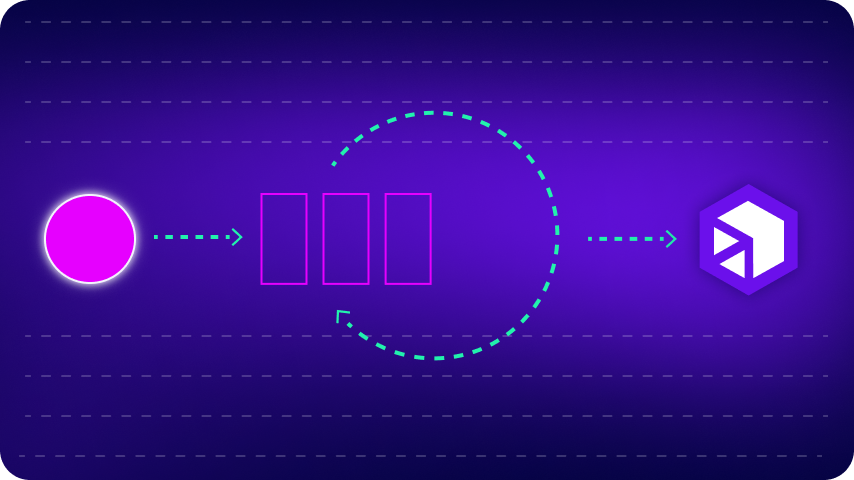
Event driven architecture graphic showing how events enter a for each loop

In today’s fast-paced digital landscape, organizations face the constant challenge of integrating diverse applications and data systems. Traditional integration approaches often struggle with scalability, flexibility, and efficiency.

Event-driven architecture (EDA) offers a compelling alternative, promising more responsive and adaptable integration strategies. This blog post delves into how Digibee harnesses the power of EDA to simplify and enhance complex integrations.

>> Book a personalized demo with our team of experts and see how Digibee’s iPaaS will bring efficiency to your business.  

Digibee: Breaking the API Monolith

Ah, APIs. They are the invisible threads weaving together the fabric of our tech lives. Yet, building them consumes a third of our coding time and, according to this report from Postman61% of the time, they’re only used for internal purposes. Can we afford the time, talent, and effort required to build monolithic APIs?

The short answer is usually no.

Digibee: The Highest Rated iPaaS on G2

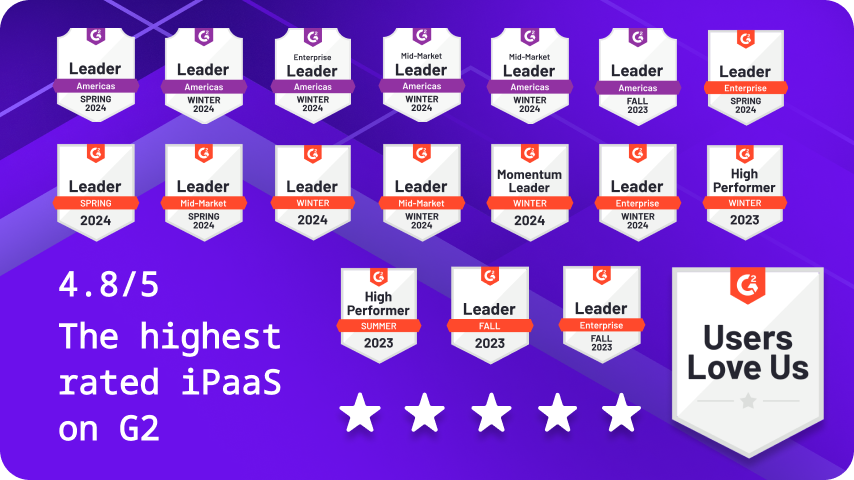
In today’s fast-paced technological landscape, the true measure of a product’s success lies in the experiences of its users. Digibee, a leader in the integration platform as a service (iPaaS) category, has earned the highest ratings from your customers in the last 2 years, with reviews highlighting its ease of use, efficiency, reliability, and cost-effectiveness.

Thanks to all the customers who took the time to share their honest insights about their experience since Fall 2023, Digibee is leading the iPaaS category for mid-market and enterprise markets, consistently through Winter 2024 and Spring 2024. Let’s dive deeper into some of the feedback making Digibee the top choice for businesses around the world.

Read Digibee reviews on G2

>> Book a personalized demo with our team of experts and see how Digibee's iPaaS will bring efficiency to your business

What Digibee customers are saying on G2

Across diverse industries and use cases, Digibee users on G2 have shared their stories of streamlined integrations, accelerated projects, and enhanced team productivity. With feedback emphasizing the platform’s flexibility, cost transparency, and scalability, these reviews reveal how Digibee is not only solving complex integration challenges but also empowering teams to achieve more with less effort. Let’s take a look at what our customers value most about Digibee.

Accelerating projects with simplified integrations

One of the design principles of Digibee’s platform has been to simplify complex API-driven architectures to streamline development workflows, cut operational costs, and accelerate deployment. A key enabler for this design principle is transforming code libraries into reusable “Capsules” that can be used and reused as needed across workflows, significantly reducing API lifecycle management.

One customer commented on their experience with API management and development and the guidance provided by our support team, “easy-to-build and deploy APIs. Digibee works well with various file types and applications. The support team is very good and has a lot of training material available.” [G2, Verified Customer Review]

Customers frequently praise our Capsules, and how they free up their teams to focus on strategy and innovation: “iPaaS with connectors for different platforms and technologies, friendly interface and less code. The possibility of creating integrations in a fast and structured way allowed us to think about ‘ what should be done' instead of 'how to do this'.” [Washington S, G2, Verified Customer Review]

Customers consistently highlight the platform’s ease of use, quick learning curve for development teams, our excellent education program and resources , modern UX, and the efficiency it brings to their integration processes resulting in a reduced time to market.  

G2, verified customer review

“The integration capacity provided by the platform is impressive and has really facilitated the connection between our various applications, services and systems within the company…Easily integrates our systems, and has a very good [short] learning curve with our developers, taking much less time to train them and thus generating value quickly.” [Lucas S., G2, Verified Customer Review]

Another customer aptly summed up why they are doubling down on their commitment. “Digibee has powerful capabilities for integrating multiple systems and technologies. This is very helpful because their customers can quickly develop their integration solutions. Our development team doesn’t have to worry about the technology aspects, they just focus on the business problem to be solved because the Digibee Platform provides all the technical components we need.” [Gabriel V., G2, Verified Customer Review]

Advancing Project Delivery with AI

Digibee’s advanced tools and infrastructure are designed to maximize efficiency and minimize routine tasks. The platform’s AI-enhanced capabilities streamline workflow creation, making it a favorite among users who need to accelerate project delivery.

One of our users commented on the ease of development through connectors for a team with limited resources, “a small team can quickly implement new integrations and improvements. The platform offers a wide variety of connectors that meet all the needs of integration projects, avoiding the need for custom code.” [Vitor M., G2, Verified Customer Review]

Another customer commented that what they liked best about Digibee’s product was the agility in development, the quick turnaround for implementation, and the fast processing time for integrations, reducing deployment time by a staggering 90%, “we were able to reduce in terms of processing one of the largest integrations more than 90% of the time.” [Alexandre J., G2, Verified Customer Review]

Improving reliability and scalability

Customers value Digibee’s Zero-Operations capability, which allows them to manage workflows effortlessly, boosting reliability and scalability . This feature enables businesses to focus on innovation rather than infrastructure management. As this customer said, “Digibee offers a scalable and maintainable integration solution for projects…( I like best the ) architecture development with integrated UI and methods to perform tests quickly. User management panel and pipeline performance visualization interface” [Murilo N., G2, Verified Customer Review]

G2, verified customer review

One customer mentioned, “before using Digibee, I had problems monitoring and controlling all my APIs, their environments, and their performance. Now I have complete control over all aspects of my integration pipelines with alerts and dashboards to view the entire health of my environment, so I spend less time and resources doing this.” [G2, Verified Customer Review]

The flexibility of the platform has also been a standout for many customers to ensure agile and efficient integrations. This customer had an extremely aggressive timeline for their integration project and was able to meet deadlines with our scalable solution. The customer noted, “the platform deserves to be highlighted for its flexibility, meeting the many different integration needs…the 'low code, approach, which not only simplifies but also greatly speeds up the development process. Furthermore, the partnership between Digibee professionals is exceptional, offering agile and efficient support to ensure continued success.” [Denis G., G2, Verified Customer Review]

Economic integrations

The pricing model pricing model is another area customers have highlighted. By ensuring they only pay for the resources they actually use, Digibee offers a cost-effective solution that aligns with their business needs. “Businesses benefit from cost savings and improved scalability, as Digibee allows easy integration of new applications and systems. Overall, Digibee provides a solution that optimizes workflows and empowers organizations to be more agile and data-driven.” [Renato C., G2 Verified Customer Review]

Carlos Renato S.., G2 Verified Customer Review

Cost effectiveness also comes through allowing the engineers to focus on the essentials of the business logic vs. boilerplate. Customers talked about Digibee enabling them to concentrate on their core logic to solve business problems, while securely and confidently leveraging the comprehensive support provided by the platform’s tools.

“Integrations are faster to develop in Digibee. The support is far superior. Digibee is our main integration tool, it reduces our development time and builds better faster integrations. We are using it to build reusable microservices and applications to move and transform data.” [Alec I., G2 Verified Customer Review]

Powerful partnerships and support

The relationship between Digibee and its customers goes beyond simply providing a service. Users appreciate the consistent support and dedication from the Digibee team, which adds immense value to your overall experience. 

Matheus R., G2, Verified Customer Review

“Digibee offers excellent support. The main positive point of Digibee is undoubtedly the quality and speed of support. Whenever necessary, we can call a customer service representative on chat and clarify any doubts.” [Pedro C., G2, Verified Customer Review]

Join our group of satisfied customers and optimize your integration strategy with Digibee

Our customers’ top ratings and glowing reviews are the ultimate testament to Digibee’s effectiveness and reliability. With features designed to simplify integration, accelerate delivery, reduce costs, and eliminate waste, Digibee stands out as the ideal choice for companies looking to streamline their integration strategies. As the leader in the iPaaS category for mid-market and enterprise markets since Fall 2023, Digibee continues to set the standard in the industry.

of expertise the Digibee difference today and join the ranks of our satisfied customers. For more information, talk to our integration experts about your specific use case and business needs and discover how our platform can transform your integration processes.

Cracking the AI Code: Presented at the Gartner Summit 2024

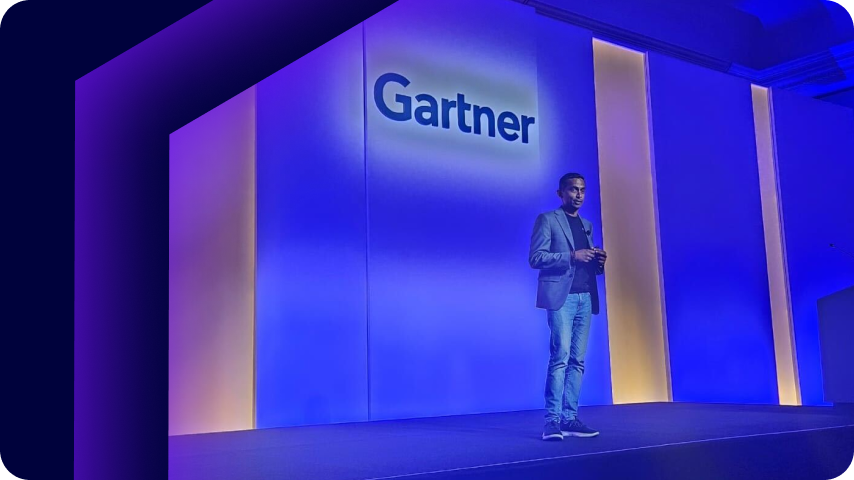
I had the honor of presenting on Digibee’s behalf at this year’s Gartner Innovation & Business Solutions Summit in Las Vegas, addressing over 150 leaders from diverse technical backgrounds and industries. Showcasing Digibee’s product is always a pleasure, but presenting a customer case study is even better. Especially when the results witnessed showed drastic reductions in overall effort and cost.

Ultimate Guide to Business System Integrations

Graphic depicting different connected systems

In today’s fast-paced business landscape, the need for seamless communication and data flow between various systems within an organization has become paramount. Gone are the days of siloed information and disjointed processes that hinder productivity and innovation. The solution? Business system integrations.

Before diving too deeply – it is important to understand the “before” state for organizations’ lacking system integration and the pain points they often bring. Lacking business integration commonly includes challenges such as fragmented data silos, inefficient workflows, manual data entry errors, and the inability to adapt to evolving business needs swiftly.

These pain points not only hamper operational efficiency, but also hinder strategic decision-making and impede overall growth.

In this comprehensive guide, we’ll cover the intricacies of business system integrations, from understanding pain points driving organizations to integrate different systems, the options for system integration, to exploring the key steps and considerations involved in the implementation process.

key points

  1. What is business systems integration?
  2. Types of Enterprise System Integrations
  3. Benefits of integrating business systems
  4. Steps to follow before implementing
  5. Optimal features to consider when evaluating integration solutions

>> Book a personalized demo with our team of experts and see how Digibee’s iPaaS will bring efficiency to your business.  

What is business systems integration?

At its core, business systems integration refers to the process of connecting disparate systems and applications within an organization to streamline and simplify data flowing from one place to another.

The ultimate goal is to create a cohesive ecosystem where data flows seamlessly between internal IT systems and third-party applications. This functionality ultimately fosters improved collaboration, efficiency, and decision-making capabilities.

System Types

Business systems integration encompasses various types of systems, including but not limited to:

  • Enterprise Resource Planning (ERP) systems: These are comprehensive platforms that manage core business processes such as finance, HR, inventory, and supply chain operations. Common examples include Oracle Netsuite and SAP S/4HANA.
  • Customer Relationship Management (CRM ): Solutions like HubSpot and Salesforce help businesses manage interactions with current and potential customers.
  • Supply Chain Management (SCM) systems: These platforms optimize the flow of goods and services from suppliers to customers.
  • Human Resource Management (HRM) Systems: Tools like Workday simplify HR processes like payroll, recruiting, and employee management.

Role of APIs

Application programming interfaces (APIs) and connectors play a crucial role in facilitating the seamless exchange of data between these different systems. APIs allow systems to communicate with each other, enabling the transfer of information in a standardized data format, while connectors act as bridges between incompatible systems, ensuring smooth integration.

Types of Enterprise System Integrations

While there are numerous integration models and methods – hub and spoke, point-to-point, star integration, and ESB – three main types should be considered:

  1. Enterprise Application Integration (EAI): This approach focuses on integrating multiple applications within an organization using middleware platforms. Examples include Integration Platform as a Service (iPaaS) such as Digibee and Enterprise Service Bus (ESB).
  2. Date iintegration: Data integration involves consolidating and harmonizing data from disparate sources to provide a unified view. Solutions like Informatica and SnapLogic are popular choices in this category.
  3. Electronic document integration: This type of integration focuses on automating the electronic data interchange for documents such as invoices, purchase orders, and contracts between systems. Solutions like MuleSoft and Dell Boomi excel in electronic document integration.

Benefits of integrating business systems

The benefits of systems integrations are extensive and should be carefully considered for organizations looking to achieve interconnectivity for a variety of reasons:

Improved data accuracy:

By eliminating manual data entry and minimizing errors, integrations ensure that data remains accurate and consistent across systems.

Improved efficiency:

Integrations streamline workflows and automate repetitive tasks, boosting productivity and reducing turnaround times.

Scalability:

Integrated systems can easily scale to accommodate growing business needs, retire legacy systems, and keep pace with new technology requirements.

Reduced Operational Costs

By streamlining processes and improving efficiency, integrations help organizations reduce operational costs and optimize resource utilization.

Better Customer Experience:

Seamless integrations enable organizations to deliver personalized and timely experiences to customers by providing businesses with a 360 customer view, enhancing customer satisfaction and loyalty.

Risk Mitigation:

Integrations facilitate regulatory compliance by ensuring data integrity and security – thereby reducing the risk of non-compliance penalties.

3 simple steps to take before implementing a business systems integration

Before embarking on a business systems integration journey or any integration project, organizations should undertake the following steps:

  1. Pull in rimportant stakeholders: Engage stakeholders from across teams and external partners to define project goals, identify risks, and develop a comprehensive plan.
  2. Analysis current systems: Evaluate existing systems – legacy systems and modern – to understand their capabilities, limitations, and compatibility with potential integration solutions. Identify the integrations that would need mapping to understand what solution would provide the best compatibility.
  3. To consider scalability and future growth: Anticipate future business needs and scalability requirements to ensure that the integration solution you choose can adapt and grow with your organization. New technologies are constantly emerging. Be sure to choose an integration solution that integrates easily with modern solutions, while remaining innovative and supporting future growth.

Key features to consider in the assessment

While organizations have the option to build integration solutions from scratch, there are many vendors, such as Digibee, that offer best-in-class SaaS solutions. When evaluating procurement integration solutions, consider the following key features:

  • Implementation complexity: Choose a solution that aligns with your organization’s technical expertise and implementation timelines.
  • Integration capabilities: Ensure that the solution supports seamless integration with a wide range of systems and applications.
  • Day-to-Day management: Evaluate the ease of managing and maintaining the integration solution, including monitoring, troubleshooting, and updating. You don’t want a solution that is more time-consuming than productive.
  • Support: Look for vendors that offer responsive support services to address any issues or concerns that may arise during implementation and beyond.
  • Date governance: Prioritize solutions that provide robust data governance features to ensure data integrity, security, and compliance.
  • Cost: Consider the total cost of ownership, including upfront licensing fees, implementation costs, ongoing maintenance, and support fees.

How Digibee can help

As organizations navigate the complexities of business systems integrations, partnering with a trusted integration platform provider like Digibee can streamline the process and drive success.

Product Overview

Digibee is a powerful iPasS that simplifies the integration of disparate business systems and applications. The most efficient, scalable way to facilitate integration projects is with an integration platform as a service, or iPaaS, such as Digibee.

An iPaaS is a platform developers use to build and manage integrations on scalable architecture—it replaces outdated integration options like ESB and includes features like reusable components, a low-code interface, managed infrastructure, prebuilt integrations, and enterprise support. 

Unlike some of its predecessors, Digibee’s iPaaS doesn’t require specialized training or a long implementation. On the contrary, it speeds up digital transformation projects by automating and simplifying the development workflows needed to connect legacy systems and cloud applications in one unified system. 

Digibee is different in that it is the only integration platform that scales application integration workflows while reducing cost, technical debt, and the burden on development teams. It allows developers to quickly build, test, deploy, govern, and monitor integrations across on-premises systems and cloud environments—they can then use the platform in tandem with API management and ETL tools for full synchronization across the organization.

Digibee is a cloud-born integration platform, that modernizes how enterprises connect applications, data, processes and people. The integration platform includes:

Digibee in action

Digibee has helped countless organizations streamline operations, increase efficiency, and drive innovation through integration across multiple industries, including retail, manufacturingand hospitality:

  • Helped a hotel chain reduce guest wait times by 80% and operating expenses by 300k annually
  • Integrated a new secure e-commerce platform for retailer Payless in over 200 stores, in 15 countries, in less than 30 days
  • Enabled an ERP cloud migration for Bauducco – simplifying and modernizing legacy systems and existing integrations, saving $2 million in project costs

Take a tour

In conclusion, enterprise system integrations offer a myriad of benefits, from improving efficiency and data accuracy to enhancing customer experiences and ensuring compliance. By following the key steps outlined in this guide and evaluating integration solutions carefully, organizations can embark on a successful integration journey that drives growth, innovation, and competitive advantage.

Ready to revolutionize your business systems integration journey? Schedule a demo or, if you prefer, Take a tour of the Digibee platform to find out how it can help with system connectivity in your own organization.

Redefining Integration: Digibee’s Visionary Solution to the iPaaS Dilemma

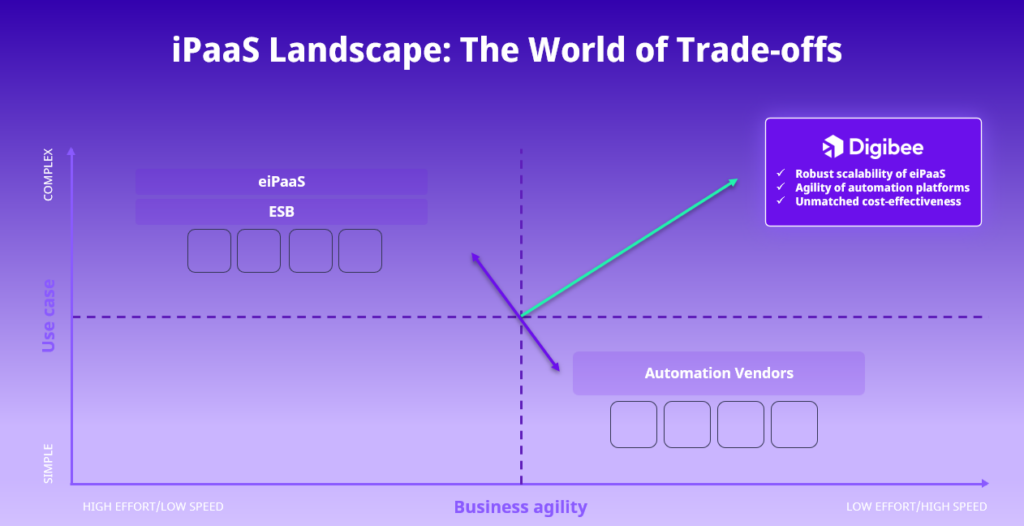
In the world of integration, companies face a common dilemma. Choose a powerful but complex and costly enterprise iPaaS (Integration Platform as a Service) with a slow payoff, or opt for an automation vendor that promises quick results but struggles under the weight of complexity.

This has been the landscape: a choice between two imperfect options.

Enterprise iPaaS vs. Automation Solutions

Traditional iPaaS solutions, while robust, come with significant downsides. They’re complex, demanding lengthy and expensive deployments that can stretch over months before yielding results. This complexity often necessitates hiring outside consultants, a luxury only the largest corporations can afford. Furthermore, these platforms tend to lock you in. The deeper you invest, the harder it becomes to leave, trapping you in a cycle of sunk costs.

Enterprise iPaaS solutions , positioned at the other end of the spectrum, offer a tempting alternative with their quick deployment and reasonable initial costs. However, this advantage is fleeting. As the need for customization grows, so do the costs and complications, eroding any early gains and pushing you back towards the high-cost, high-complexity scenario you hoped to avoid.

Digibee pays close attention to these industry pain points and has built a solution that addresses them head-on, positioning itself in a unique spot within the iPaaS quadrant.

Graphic of iPaaS landscape

>> Book a personalized demo with our team of experts and see how Digibee’s iPaaS will bring efficiency to your business.  

Digibee's approach: the best of both worlds

Digibee offers a new perspective, offering a platform that combines the robustness of enterprise solutions with the agility and cost-effectiveness of automation tools. Here’s how:

Integration without waiting: Digibee accelerates integration through reusable building blocks (called Capsules), and built-in automation for tasks that would otherwise slow you down. This combination delivers quick and efficient setup without sacrificing depth or flexibility. With Digibee, the integration design is in your hands, and the heavy lifting is taken care of by the platform. Need more computing capacity, an event queue, parallel processing, or a load balancer? The platform intelligently manages these for you. This drastically cuts down on the time and effort traditionally required, making integrations faster and more seamless.

AI-powered efficiency: The leverages AI to automate the generation and updating of documentation as integrations are built or modified. This ensures that documentation keeps pace with development, reducing manual overhead.

Empowering developers: Digibee’s use of JSON makes the platform accessible to a broad range of developers, eliminating the need for specialized knowledge or external consultants. This democratizes the integration process, enabling in-house teams to tackle complex projects with confidence.

Transparent and predictable pricing: Adopting a cloud-native architecture, Digibee ensures that costs are tied directly to usage, with pricing that scales according to your needs. This model offers freedom from the constraints of per-endpoint fees or data throughput limits, providing clarity and control over your integration expenses.

Flexibility and freedom: With Digibee, companies are not locked into their platform choice. The ease of transferring JSON transformations means that switching to another platform, if needed, is straightforward, mitigating the risk of vendor lock-in .

Why Digibee's approach matters

The iPaaS market has long presented businesses with tough choices: capacity versus cost-effectiveness, scalability versus speed. With Digibee, that era of dilemmas is over. It’s not just about connecting systems, it’s about unlocking possibilities, simplifying complexities, and prioritizing your needs and concerns at every step. 

Digibee’s solution speaks directly to the core needs of companies navigating the complex iPaaS landscape. It offers a way to engage with integration that is both deep and flexible, without the traditional trade-offs of cost, complexity, or speed.

By addressing these critical pain points, Digibee offers a platform where companies can confidently build and scale their integrations, backed by the support and flexibility needed to adapt to the ever-changing digital environment.  

See Digibee's approach in action

Book a personalized demo from our team of experts and let us walk you through how Digibee’s iPaaS solution meets the market where it is, providing the tools and approaches that businesses have been seeking in the iPaaS space.

Modern iPaaS: Just What the Doctor Ordered

Many legacy iPaaS users, like you, face common obstacles. These challenges range from end of support with their current provider, to the necessity of modernizing their architecture to support new technologies, to justifying increasing update and support costs. Additionally, while their overwhelmed team struggles to efficiently manage their integrations, their IT backlogs pile up.

How to Break Up with Your Legacy iPaaS

Concept image of breaking up with legacy vendors and choosing Digibee

Look, we get it, breakups are never easy. But how often in hindsight do we know we not only did the right thing, but actually, we should’ve done it sooner? That’s how Digibee customers feel once they finally decide to dump their Legacy iPaaS for Digibee’s serverless, modern platform.

Our customers have a myriad of reasons to leave: end of support of a legacy solution, deploying a new technology requiring modern architecture, over-extended IT teams managing integrations causing priority work to pile up, or the ever-increasing update and support costs that add little to no added value.

Whatever the reason, putting off the inevitable prevents true scalability, slows growth, hurts morale, and ultimately impacts your bottom line. It’s time to move on. Digibee’s iPaaS not only empowers your development team and maximizes their capabilities, we also enable your transition quickly, cost-effectively, and without heartbreak. Really.

>> Book a personalized demo with our team of experts and see how Digibee’s iPaaS will bring efficiency to your business.  

Ending a relationship is hard

Change is often unavoidable – you can choose to prepare for it, or choose to react to it. We’ve heard all the reasons preventing organizations from leaving their co-dependent legacy iPaaS relationship. We aren’t pretending they aren’t valid, but making the change with Digibee may not be as hard as you think

We’ve listed a few of these “relationship struggles” below. If any of them resonate with you, talk to our team. We can address each of your concerns and put your mind at ease, strategizing your potential replacement and moving forward with a healthier integration partnership.

But, it’s comfortable

You’ve been with your legacy solution a long time. You have an understanding and leaving feels too disruptive. “We’re fine. It’s fine. I’m fine.” Sound familiar?  

Many technology professionals have lost sleep over technology replacements that proved so difficult to deploy that the new solution is underwhelming in comparison. Sure, change can be hard, but the reality is that ignoring necessary change can lead to your organization getting stuck – risking the growth and innovation needed to succeed and outshine your competitors.  

But, we know how it works. With IT teams already overextended, the decision to replace an existing “good enough” technology needs to be justified with an undeniable reason to act and a clear, quantifiable business outcome. Often, organizations don’t seek an alternative solution until a crisis arrives making the decision for them.

Changing vendors is an investment and you need assurance that disruptions and downtime will be minimal. Digibee’s implementation model minimizes downtime and includes onboarding your team quickly so they can be valuable almost immediately. Did we mention we've done this before

The way we were

You’ve been creating code together for years, there’s so much history and invested time. How can you just leave it all behind?  

The mere thought of walking out on your existing in-house solution and all its interconnections and customizations gives you so much anxiety that it seems easier to just stay. Digibee’s solution is not just robust and scalable, but it’s also low-code and composable. Change management is easy and repeatable, so your development team doesn’t have to continue down the usual path of constant customizations and tangled code.  

Digibee’s iPaaS empowers all developers – not just integration specialists – to easily build and monitor integrations. We are the first serverless iPaaS platform. Our architecture is born in the cloud and built on microservices. You can leave the complexity behind and position yourself for a future already built to be scalable and grow as your business grows.

Maybe it’s time to spice things up  

You chose your existing integration product for a reason. Opening up to a new vendor, especially when you already have one, might sound like more of a headache, but it could be the solution you need to alleviate your issues.

Sometimes, the right solution is a hybrid model, where Digibee works in tandem with your existing platform. Our team will take the time to understand the rationale and purpose of your existing solution. Whichever solution best suits your organization’s needs, Digibee’s team can walk you through step-by-step how they would approach each of your concerns and support every aspect of your transition.

The financial challenges would be too much  

You’ve invested so (so) much in this relationship. It’s hard to justify investing in another solution when technically, you already have one.  

We know budgets are constrained in our current economy. Let our team walk you through a detailed ROI analysis that explores the pros and cons of spend on your current solution versus Digibee. The reality often is, that the savings in time, resources, and money that a replacement or co-existing iPaaS can deliver, can be significant for your business.

Modern iPaaS solutions like ours are actually extremely cost-effective, especially compared to legacy solutions. Transitioning from an on-prem solution to a cloud solution also turns your investment from CapEx to OpEx, which provides additional financial benefits. And, our straight-forward, transparent pricing model includes onboarding, implementation and support services. We can empower your team to deliver in just six weeks or less.  

Change nothing, and nothing ever changes

If you’re tired of feeling stuck in a legacy relationship ( and we didn’t say partnership for a reason ) and looking to strategize the next steps for your business, we’d love to hear from you. 

Contact our team today and let us walk you through how we can address each of your pain points with our simple, fast, modern approach to integration. 

The Right Tech Stack: Single Vendor or Best-of-Breed? | Digibee

As a business and technology leader, some of the most critical technology decisions you face center on whether to broadly adopt an integrated suite from a single vendor or assemble a “best-of-breed” stack of specialized tools.

The associated set of decisions is the underpinning of your technology strategy, and the decisions you make will profoundly impact the flexibility, innovation and costs of your tech stack as you grow, scale and evolve your organization.

>> Book a personalized demo with our team of experts and see how Digibee’s iPaaS will bring efficiency to your business.