Three myths of modern integration
Founder and president of digital transformation analytics firm Intellyx, Jason Bloomberg examines three myths of modern integration in this September 2021 feature.

publicado em
September 15, 2022
Founder and president of digital transformation analytics firm Intellyx, Jason Bloomberg examines three myths of modern integration in this September 2021 feature.
Founder and president of digital transformation analytics firm Intellyx, Jason Bloomberg examines three myths of modern integration in this September 2021 feature.
Jason Bloomberg, President, Intellyx, September 2021
The world of enterprise IT has completely transformed over the past decade. Today, we expect and demand the ability to change at scale.
IT infrastructure must be inherently dynamic, without any limitations on the scope or scale of any specific application. Cloud native computing has emerged to meet these needs.

However, businesses must continually deal with existing legacy assets in the context of this modern IT landscape. Cloud-native computing raises the bar for enterprise integration, as organizations can no longer afford to slow down when connecting old assets to new ones.
To meet this need, a new class of integration technology has emerged that is low-code, cloud-native, and supports changes across the entire software lifecycle.
>> Book a personalized demo with our team of experts and see how Digibee’s iPaaS will bring efficiency to your business.
Commenting on the ubiquity of change, it was the ancient Greek philosopher Heraclitus who said that it was impossible to step into the same river twice. The guy may have been prescient, considering the state of enterprise IT today.
Change is not only constant in the world of technology, but it affects every aspect of IT, from customer expectations to the underlying infrastructure. In many situations, change is even accelerated.
The ability to support change, however, is not enough. IT organizations must be able to support change at scale. This widespread requirement has given rise to cloud-native computing: a paradigm shift in how organizations build and leverage technology to support this type of change.
The ability to support change, however, is not enough. IT organizations must be able to support change at scale. This widespread requirement has given rise to cloud-native computing: a paradigm shift in how organizations build and leverage technology to support this type of change.
Cloud-native computing, however, can be complicated and difficult – and it wouldn’t be worth the effort if customers weren’t demanding better, more dynamic technology-centric capabilities from the companies they do business with.
Putting customers at the center of IT efforts is at the heart of digital transformation. This transformation is customer-driven and technology-enabled – and it’s becoming increasingly urgent now that the COVID pandemic is coming to an end.
Standing in the way of this mandate to leverage cloud-native computing to deliver digital transformation is the full spectrum of technical debt, particularly within IT. Decades of expedient decisions and generations of now-legacy technologies present a formidable barrier to the scale of change that today’s enterprises desire.
Breaking up old technology is rarely, if ever, the answer. To move forward in the face of technical debt, IT leaders must apply a deliberate combination of modernization, migration, and integration—updating, moving, and connecting existing assets to new ones, respectively.
Integration, in particular, requires a new way of thinking to support the cloud-native mantra of ‘change at scale.’ We must dispel old integration myths to move forward with cloud-native computing and, by extension, our digital transformation priorities.
Low-code technologies have been around for decades, but the modern generation of low-code tools and platforms focuses on reducing the burden on professional developers by fostering greater collaboration with stakeholders while accelerating software development.
Low-code, however, is more than just building standalone applications. Within organizations, software creation never stands alone. There’s always a database to query, an API to connect to, or a connector to integrate.
Some low-code tools struggle to address this reality. Many low-code tools can help app builders handle many of these basic integration scenarios, but leave the more complex ones to hand-coding.
This limitation, however, is quickly becoming obsolete as modern low-code tools help application developers with increasingly sophisticated integration scenarios without requiring them to write a single line of code.
The need for change at scale gave rise to microservices and containers, which in turn put the Kubernetes container orchestrator at the forefront of the cloud native movement.
Many early adopters of Kubernetes take advantage of its ability to support change at scale to create new microservices that integrate into new applications.
Cloud native computing, however, is broader than Kubernetes and supports much more than just new applications. In fact, the typical enterprise landscape is a hybrid mix of existing ‘brownfield’ assets as well as newer capabilities that we are calling ‘greenfield’.
The big picture of cloud-native computing is the presence of a control plane abstraction that supports and enforces policy-based behavior in even the most complex hybrid IT environments.
Greenfield is one component of this bigger picture, to be sure, but connecting the new to the old—green to brown—is the more common and, indeed, more valuable scenario.
Traditional, hard-coded integration, however, is too inflexible to support this hybrid IT vision for cloud-native computing. Instead, integration itself must be policy-based and inherently flexible to support the cloud-native applications of today and tomorrow.
To reap the benefits of the shift to cloud-native computing at scale, we must break free from the shackles of traditional hard-coded integrations.
Even as integration technologies have evolved, from the enterprise application integration tools of the 1990s to the enterprise service buses (ESBs) of the 2000s to the RESTful approaches of the 2010s, IT professionals have always treated integration as something they do before deployment. In other words, connect things before they run.
The goal of being able to dynamically change integrations at runtime was a dream from the days of ESBs and Web Services. Early Web Services implementations supported auto-discovery and auto-integration, where endpoints could negotiate with each other automatically at runtime.
In practice, however, this type of dynamic integration proved to be impractical – and Web Services became yet another endpoint for hard-coded integrations.
To date, the use cases for fully automated integrations that can dynamically change at runtime are limited. The sheer variety of different types of changes is simply too much for automated integrations to handle.
To balance these shifting priorities of integrations at scale, we must consider integration as a full lifecycle activity.
In other words, we must break free from the waterfall-centric belief that the pre-deployment and post-deployment phases of software are somehow immutable. Instead, we must take a page from the agile playbook and approach the software lifecycle in an iterative manner.
We must consider integration as a full lifecycle activity. In other words, we must free ourselves from the waterfall-centric belief that the pre-deployment and post-deployment phases of software are somehow immutable.
The cloud native way of thinking takes this iterative approach to the extreme with modern development practices like DevOps, CI/CD, and GitOps.
We expect constant change without slowing down the deployment of new and updated software, the theory goes, so we allow and plan for changes in the production environment.
This modern, dynamic approach to building software that supports change at scale also applies to integration. We must be willing and able to build and change integrations post-deployment in an iterative and agile manner.
The policy-based constraints of CI/CD and GitOps certainly help in this new way of integrating software. Given the wide variety of integration scenarios and the diversity of changes that can affect them, however, a low-code approach to integration becomes absolutely essential.
Remember, low-code empowers development teams and stakeholders to be more collaborative and iterative – not just when building applications, but also when running and updating them.
Integrations won’t always be perfect in the face of changing requirements and dynamic applications, but with low-code, the people responsible for these integrations have the power and control to keep them up to date throughout the software lifecycle.
There are many integration products on the market and it seems that analysts keep coming up with new names for the various categories they ostensibly fall into.
We have Integration Platform as a Service (iPaaS), Enterprise Integration Platform as a Service (eiPaaS), and Hybrid Integration Platform (HIP). We also have overlapping product categories that large analyst firms have a harder time tracking, including low-code integration tools and cloud-native integration tools.
Don’t let analysts and their industry terminology confuse you. Instead, look for the key capabilities needed to support integration change at scale.
Integration platforms like Digibee are, first and foremost, cloud-native. They not only leverage microservices, containers, and Kubernetes, but they also provide a policy-based control plane that allows IT teams to manage integrations across the entire software lifecycle.
Digibee's platform is also low-code, providing straightforward visual interfaces that simplify and accelerate the work of professional developers, promoting greater collaboration and support for changes throughout the lifecycle.
In fact, Digibee’s support for the full integration lifecycle is another must-have feature of any modern integration tool. We can no longer relegate integration activities to the pre-deployment phase of a software effort.
Cloud-native computing offers scaled change across the entire software lifecycle, and integration technology must meet this challenge as well.
Jason Bloomberg is a leading IT industry analyst, author, speaker, and globally recognized expert on several disruptive trends in enterprise technology and digital transformation.
He is the founder and president of digital transformation analyst firm Intellyx. He is ranked #5 on Thinkers360’s 50 list of the top 2020 global thought leaders and influencers in cloud computing, #50 on Jax’s 50 list of top low-code analysts in the 2019 Influencer5 Low-Code2018 study, #15 on Onalytica’s list of top digital transformation influencers in 2017, and #XNUMX on Jax’s list of top DevOps influencers in XNUMX.
Mr. Bloomberg is the author or co-author of five books, including Low-Code for Dummies, published in October 2019.
Digibee has developed its hybrid integration platform to rapidly connect enterprises to the digital world, leveraging Kubernetes, microservices, low-code, and a unique delivery model. Its innovative and flexible platform solves the integration challenge faster and more efficiently than any other integration approach on the market. The innovative approach enables customers to unlock innovation by simplifying integration and treating it as an abstract capability rather than a one-off endeavor.
Its holistic and agile approach to integration enables companies to accelerate decision-making, enhance customer experience and achieve better business outcomes quickly and scalably, without major investments. Digibee has offices in São Paulo, Brazil; Weston, Florida and Denver, Colorado.
Copyright © Intellyx LLC. Digibee is an Intellyx client. Intellyx retains final editorial control of this article. Image credits: Marcio Ramalho, David Antis, Dominic Melton, and Bart E.
©2021 Intellyx LLC. https://intellyx.com
Rodrigo cofundou a Digibee com base nos princípios de simplicidade, agilidade e relações humanas sólidas, com o objetivo de reduzir a dependência de desenvolvedores e permitir que clientes com menos conhecimento técnico acelerem suas transformações digitais com mais eficiência e menor custo. Formado em Ciência da Computação e com MBA, Rodrigo ocupou cargos de liderança na CA Technologies e na Zup Innovation antes de fundar a Digibee.
POSTS RECOMENDADOS
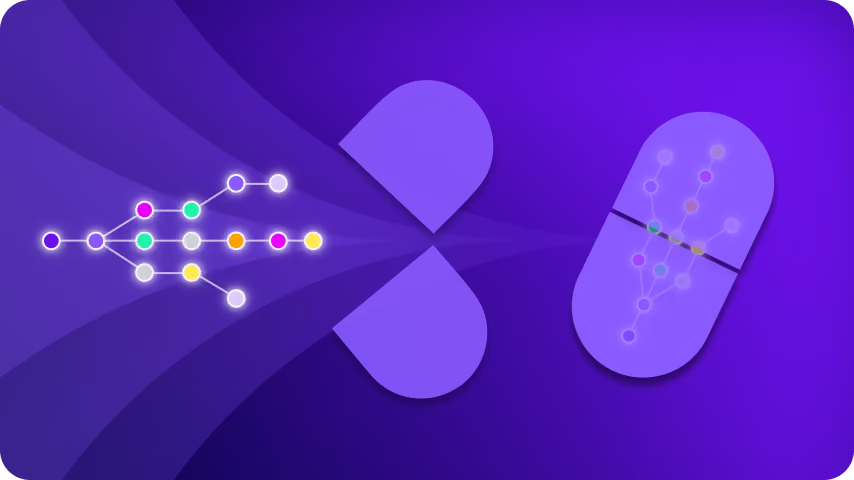
Descubra como as Capsules da Digibee simplificam integrações com funções reutilizáveis, reduzindo código duplicado, custos e a complexidade das APIs.
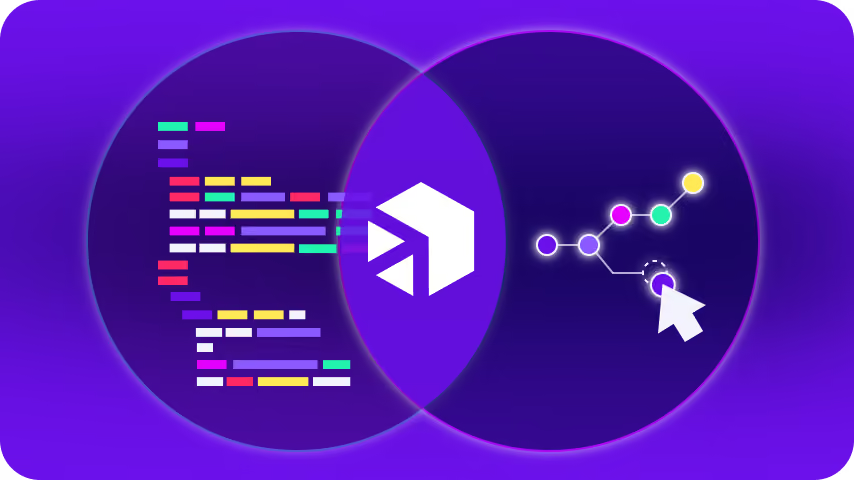
Uma análise de como a solução de integração da Digibee atende às principais necessidades das empresas diante da complexidade do mercado de iPaaS.

Se você enfrenta muitos dos desafios comuns aos usuários de plataformas legadas, um iPaaS moderno e low-code pode ser a melhor solução.
Hoje, desenvolvedores usam prompts para que ferramentas de IA construam por eles. Empresas de software criaram servidores MCP que permitem trabalhar em suas plataformas diretamente por uma interface de chat com IA. Mas existe uma abordagem melhor: começar por uma especificação.

Entenda por que o vibe coding não é suficiente para infraestruturas corporativas e por que especificações consistentes são essenciais.

Um engenheiro de IA conta um pouco do que precisou fazer para construir o Digital Worker da Digibee.