Growing Pains: 3 Key Enterprise Integration Challenges You May Be Facing
Explore the three key enterprise integration challenges uncovered in the Gartner Maturity Model and how to overcome them in your digital transformation.
Maturity comes with age and experience. This adage is as true for a business as it is for an individual. Anyone can look back to an instance where they were learning a new skill and wish they could have known what they know now. Hopefully most of us can similarly think of something we DIDN’T do because we learned from someone else’s experience.
Click and Learn More
This universal experience of growth as a process makes a Maturity Model a performance measure that is particularly quick and easy to comprehend and a powerful tool for gaining alignment for business stakeholders in both assessing the current state as well as calculating the best next steps.
>> Book a personalized demo with our team of experts and see how Digibee’s iPaaS will bring efficiency to your business.
A Data Integration Maturity Model
In this way, Gartner's Integration Maturity Model offers an excellent self-assessment tool for any company that is considering or already implementing enterprise integration.
A Snapshot of the 5 Phases of EI Integration Maturity: :
Getting Started
Approximately 30% of Gartner clients*Stage 1: Ad HocNo general strategy, any integration is done on a case-by-case basis
Stage 2: Enlightened
Recognition that integration is a problem; tools begin to be selected, but there is no defined responsibility Standardization
Approximately 60% of Gartner clients*
Stage 3: Centralized
An ICC is formed to manage platforms, tools, and experts. It defines best practices to promote consistency.
Stage 4: Collaborative
A shift towards a more distributed competence is achieved through the formation of an ISET and the implementation of a Hybrid Implementation Platform (HIP)
Business utility
Roughly <5% of Gartner clients*
Step 5: Self-service
With integration expertise now embedded within the organization, ISET and HIP support a delivery model that is democratized
*Estimates based on Gartner's 2019 Business Application Integration survey
Growing Pains? You're Not Alone
This distribution of businesses on the journey towards full integration shows similar trends to what State of Enterprise Integration Report findings uncovered with our own market analysis of 1000+ participants, with 71% self-reporting are actively planning to adopt, supplement, or replace their integration technology.
If so many businesses plan to implement EI, why are there so few that succeed in reaching maturity? What enterprise integration challenges are standing in their way?
“Technology leaders understand the value and urgency in integrating the enterprise, yet many are frustrated in their efforts to achieve this result.”
Peter Kreslins CTO and Founder, Digibee
Three main challenges of enterprise integration
If, upon rating your business against Gartner’s Data Integration Maturity Model, you find yourself somewhere in the beginning or middle stages, consider this a fantastic opportunity to gain speed and efficiency by learning from those who have gone before and where they have succeeded or struggled.
Three distinct challenges emerged for those who have already undertaken enterprise integration:
1. Investing in the future still costs money
Sure, “technology is the future”, but profitability has to be the future too, right? Since not all technology represents the same value to a specific business, the step that has to happen before the step of integration is getting the budget approved; a sometimes challenging feat. For this reason it is perhaps unsurprising that Gartner writes:
“Justifying investment in integration competencies is difficult, particularly compared with other priorities with a clearer return.”
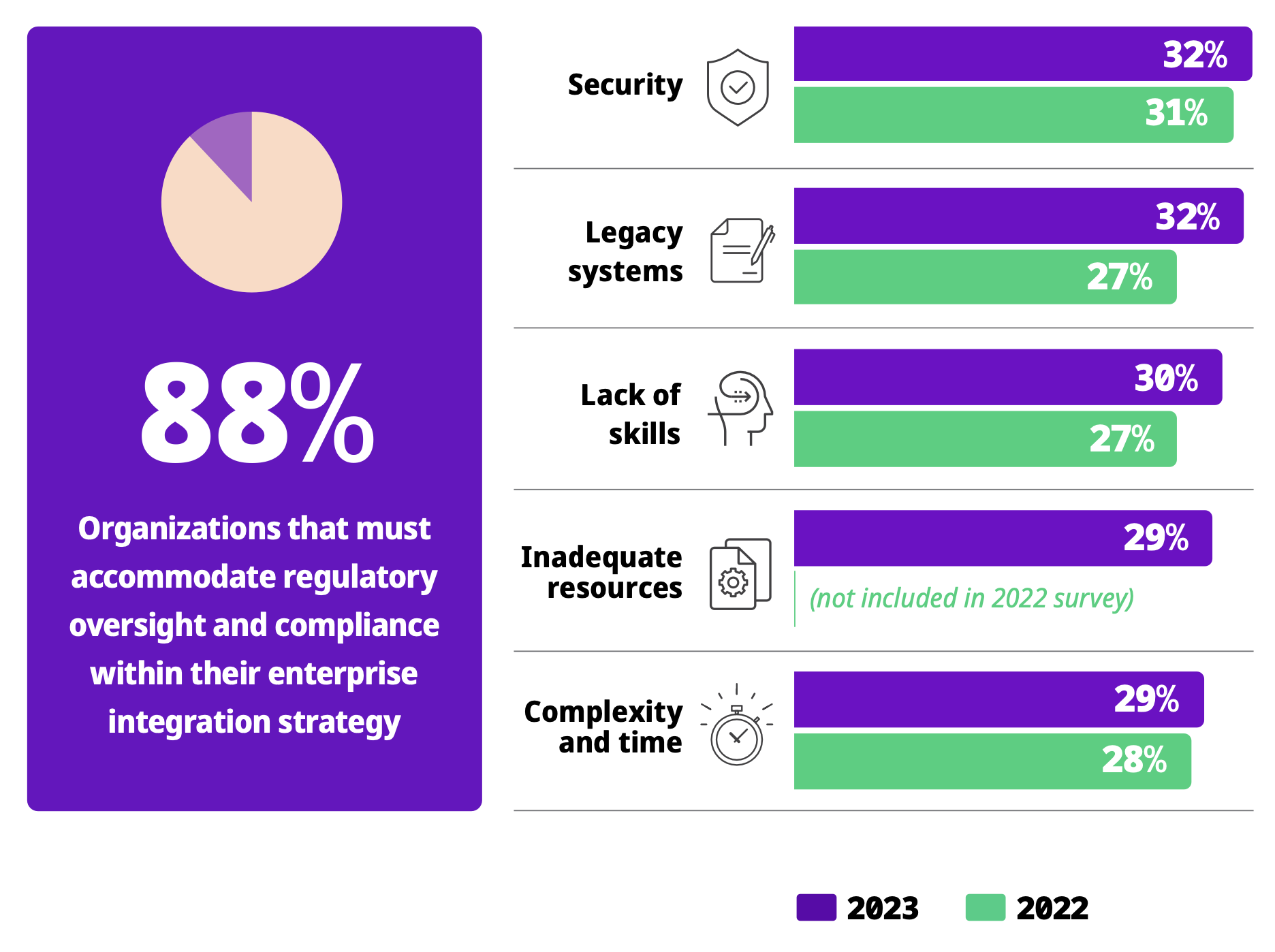
This quote mirrors Digibee’s findings precisely, with budget being the top enterprise integration challenge:
2. Short-Term Gain, Long-Term Pain
Focusing on short-term goals of the existing application landscape can feel like quick progress, but is another key challenge outlined by Gartner. Immediate needs can often be addressed in multiple ways, but those choices may have unintended consequences that limit options down the road.
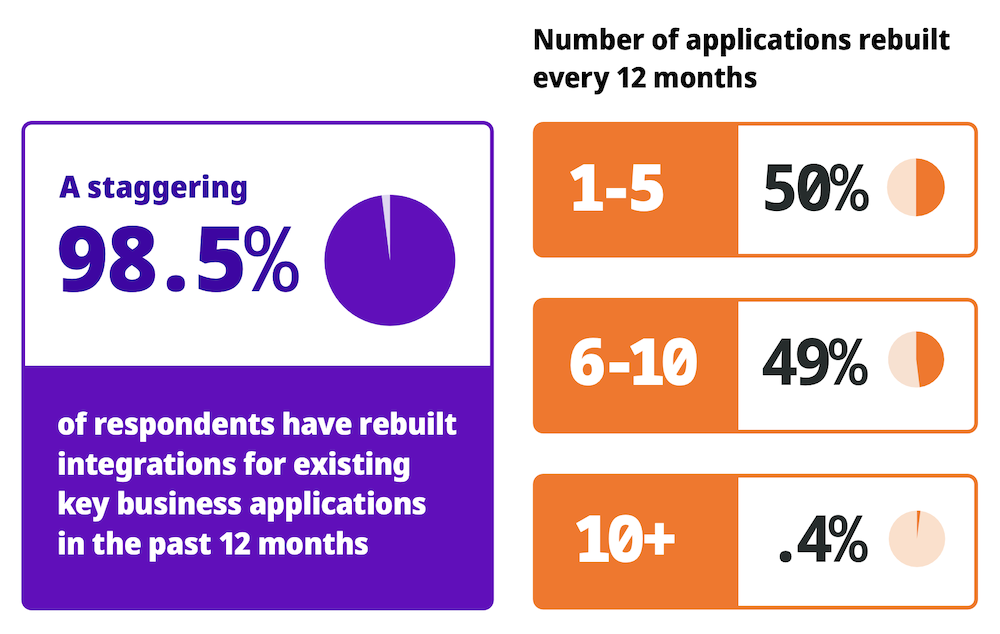
A lack of strategy produces a series of stop-gap solutions that need to be continually rebuilt or replaced. Digibee’s 2022 Report found almost 98% of users opting to rebuild at least one integration within the last year,with 48% rebuilding 6 or more; a cycle that severely disrupts the daily operations of a business.
3. Consistency vs. Agility
Gartner cites centralized integration teams’ lack of agility to cope with the demands of a business-driven, product-centric delivery as their third key challenge.
If the Gartner maturity assessment encourages teams just beginning their EI journey to move from Phase 2 (Enlightened) to Phase 3 (Centralized) to improve consistency, for those who have achieved Phase 3 maturity why it is important to shift to a more decentralized, then democratized, delivery to advance further?
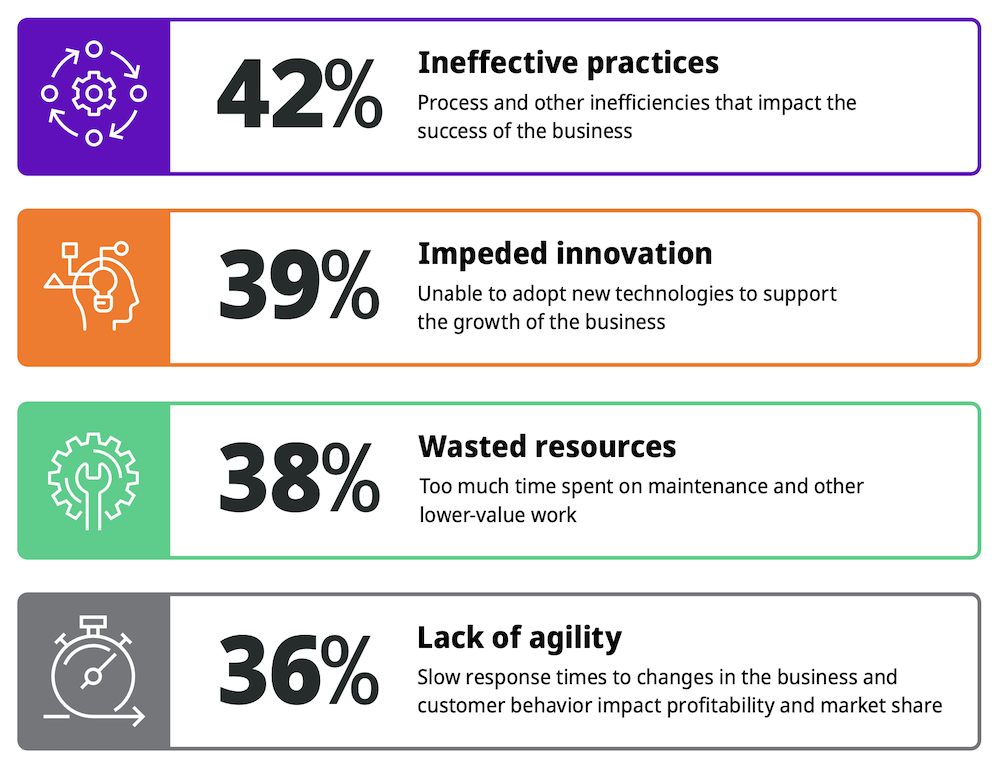
Digibee’s Report found impeded innovation and ineffective practices were tied as the top negative impact experienced by business users of a poor integration; lack of agility also topping the list.
Poor integrations have a direct (and negative) impact on the business:
These data integration challenges can reflect a tipping point where EI business use cases have expanded and increased in complexity to a point where one centralized integration team can no longer cope, turning them into more of a bottleneck than an effective means of governance.
An EI Roadmap for Longevity, Profitability and Agility
To effectively mitigate the common challenges faced in Enterprise Integration, Gartner recommends a “a realistic, step-by-step plan and investment approach”. To synchronize each step you take with your end goals of a mature integration, we found taking the time to get two main pieces right will pay dividends for longevity, profitability, and agility in EI:
Align goals and priorities
Make a list of business goals with all your stakeholders up front to get alignment on a clear ranking of priorities. Ensure you take the time to consider these end goals and that each step you are taking today aligns with them.
Although it can be difficult to bring such a varied group of business leaders including the C-Suite, IT team, and product team, to a consensus, taking a piecemeal approach will lead to amplified friction between stakeholders down the line and often results in a business getting stuck in one of the middle stages of maturity and a loop of costly rebuilds.
Map the key players
Factor in budget and how quickly your platform needs to be operational to determine the best combination of internal and external resources.
During this exercise, be sure to craft your resourcing plan to reflect future stages, and anticipated changes in needs as your EI practice matures.
The right tool: iPaaS for your integration journey
The final pivotal piece in a smooth journey to EI maturity is choosing the right tools.
Where agility and speed are core benefits of enterprise integration, don’t lose those gains by being locked into a rigid approach. Opting for an Enterprise Integration Product-as-a-Service model such as Digibee will accommodate the evolving needs of your team whether you have an established ISET or only just getting started. Digibee’s low-code approach is infinitely scalable, and a lower upfront investment than building a custom integration solution.
Take a look at all the benefits your organization can gain by partnering with Digibee – or book a no-obligation demo to see our solution in action.
Rodrigo cofounded Digibee based on the principles of simplicity, agility and strong human connections — with the goal of freeing less technically savvy customers from their reliance on developers for more rapid, cost-effective digital transformations. After receiving a Bachelor in Computer Science and an MBA, Rodrigo went on to senior roles at CA Technologies and Zup Innovation.
RECOMMENDED POSTS
AI & Agents
What it took to make an LLM build enterprise integrations
An AI engineer explains some of what he had to do to build the Digibee Digital Worker.
3 ways to add AI value to deterministic workflows in financial services
AI will not replace deterministic workflows in financial services. It complements them with reasoning and context capabilities where rules alone are not enough.
What differentiates an AI-native platform from an AI-powered one? A platform rebuilt for agents, with specialized workflows and collaboration between people and AI.