Forrester TEI Report: Enterprise Integration for Financial Services
The dollars and sense behind enterprise integration for Financial Services. A study from the experts at Forrester Consulting.

PUBLISHED
February 14, 2023
The dollars and sense behind enterprise integration for Financial Services. A study from the experts at Forrester Consulting.
In a recent engagement with Forrester Consulting, we asked the experts to put hard numbers behind the value Digibee delivers to our customers. The result? The Total Economic Impact™ Of Digibee's Integration Platform as a Service (eiPaaS) report.1, an in-depth review that quantifies the upside of Digibee’s eiPaaS technology.
To contextualize the research, Forrester conducted interviews with existing Digibee customers, taking what they learned and using it to create a composite customer: a financial services organization we’ll call FinCo. This blog post explores in detail the total economic impact delivered to FinCo after implementing Digibee.

Enterprise integration means many things to many different industries. For manufacturing, connecting disparate systems and data provides a comprehensive view of operations for real-time monitoring, which in turn optimizes productivity and time to market.
In retail, enterprise integration enables a composable technology infrastructure, allowing the retailer to quickly adopt new innovations that support and enhance digital customer experiences.
In financial services (FiServ), enterprise integration supports business evolution, especially important in an industry where legacy infrastructure is often an obstacle to progress. By connecting the old with the new, a FiServ organization can easily keep pace and often lead within its market space.
Unlike other industries, the regulatory landscape for FiServ is particularly complicated. For example, in the U.S.—and depending on the type of FiServ—the company may need to provide dedicated oversight regarding anti-money laundering (AML), know-your-customer (KYC), know-your-business (KYB), and other rules.
Additional considerations include application and data security, with the business responsible for mitigating risks associated with the software development lifecycle (SDLC), data management, access handling, patch management, and more. These issues become even more complicated when you include third-party risk management that extends to service providers, partners, and other strategic relationships.
Keeping track of so many moving parts is extremely difficult. Doing so in real time to ensure real-time responsiveness requires a level of connectivity that enterprise integration can easily support.
The composite client featured in the independent economic impact analysis – FinCo – is a global financial services company. The organization supports two distinct models: B2B and B2C, providing sales, service and support to millions of corporate and consumer customers.
With a strong brand and global operations, the business employs 20,000 people and generates annual revenue of $5 billion.
Prior to Digibee, FinCo’s existing integration strategy relied on point-to-point solutions that used custom code. The work was supported by six developers (FTEs) who spent 50% of their time building and maintaining integrations.
The point-to-point integration model was complicated and presented several common challenges:
To solve these challenges, FinCo needed to increase capacity to complete more integrations at a faster pace. Rather than a point-to-point DIY solution, the company wanted to employ a modern integration strategy to be able to handle complex integrations more easily. FinCo also wanted to leverage the flexibility of a cloud-based integration platform versus an on-premises solution.
Forrester Consulting quantified the value of Digibee to FinCo based on a number of benefits:
After Digibee was implemented, FinCo saw immediate returns. For example, it increased developer efficiency. Before Digibee, the number of hours FinCo spent building a single integration averaged 886 hours. In year 1 with Digibee, this decreased by 50% to 443 hours. In years 2 and 3, the average dropped further to 222 hours, for an overall efficiency increase of 75% over the legacy point-to-point solution.
Overall, FinCo achieved significant savings, operational efficiencies and IT cost reductions with Digibee:
ROI: 232%
Return on Investment (ROI): Expected return in percentage terms. Calculated by dividing net benefits (benefits minus costs) by costs.
PV of benefits: US$5.94 million
Present Value (PV): Present or current value of cost and benefit estimates given at an interest rate.
NPV: US$ 415 million
Net Present Value (NPV): Present or current value of future (discounted) net cash flows given an interest rate (the discount rate).
Return: <6 months
Refund Period: The break-even point for an investment. This is the point in time at which the net benefits (benefits minus costs) equal the initial investment or cost.
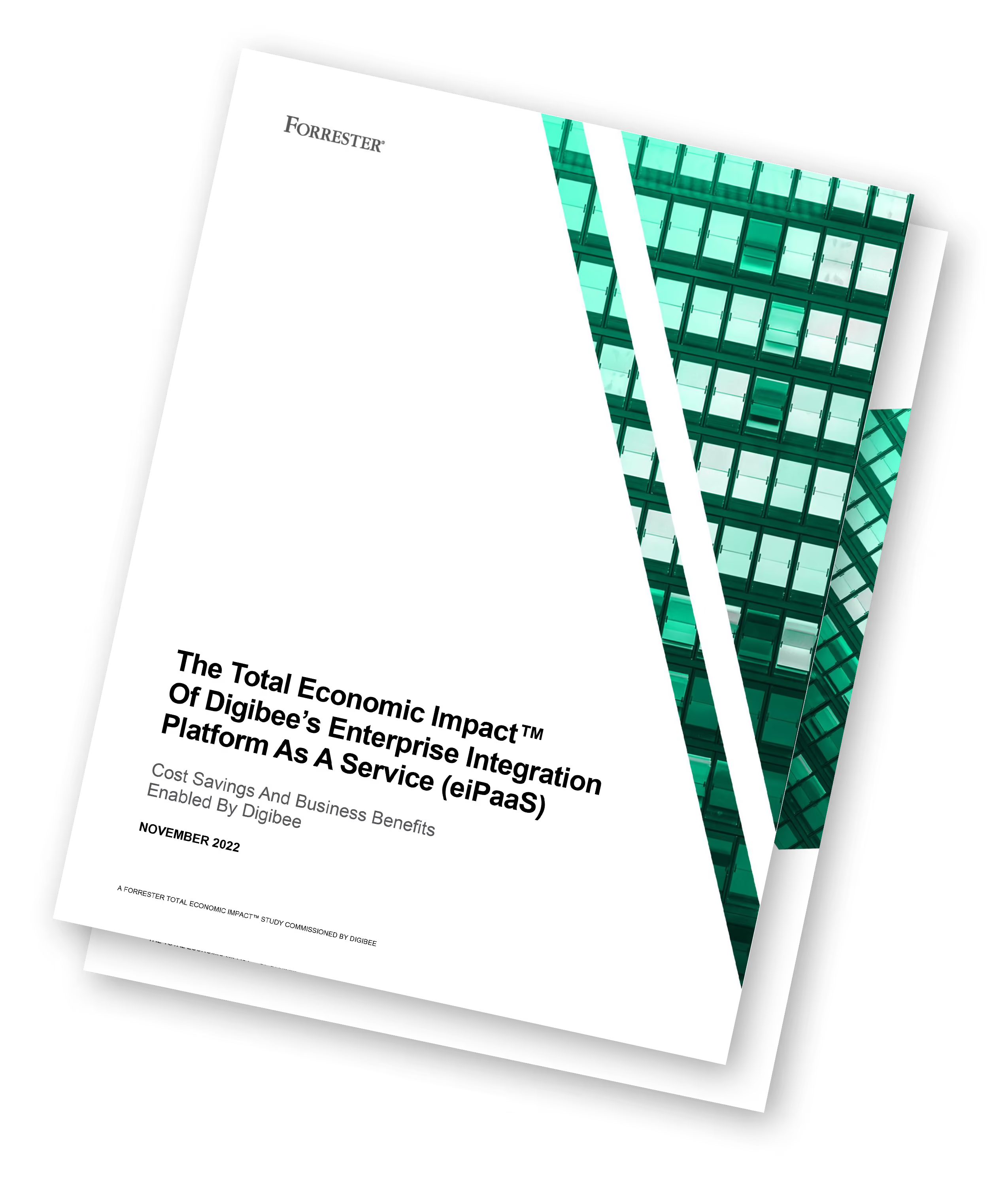
As detailed in the Forrester study, Digibee’s enterprise integration platform increases the productivity (build and maintenance) of developers and IT professionals. Digibee’s low-code platform enables junior developers to do work previously relegated to senior developers.
Digibee streamlines and reduces the cost of the entire development process and, coupled with an industry-leading enablement delivery model, sets customers up to adopt an eiPaaS autonomously and easily.
For more information, read Digibee's Total Economic Impact of Integration Platform as a Service (eiPaaS) report or contact us for a Digibee eiPaaS demo.
1 A commissioned study conducted by Forrester Consulting on behalf of Digibee
Rodrigo cofounded Digibee based on the principles of simplicity, agility and strong human connections — with the goal of freeing less technically savvy customers from their reliance on developers for more rapid, cost-effective digital transformations. After receiving a Bachelor in Computer Science and an MBA, Rodrigo went on to senior roles at CA Technologies and Zup Innovation.
RECOMMENDED POSTS
Discover how logistics integration in healthcare prevents stockouts, improves patient care, and reduces waste with automation and real-time visibility.

What is the best IT solution for retail integrations going forward? Point-to-Point (P2P), Enterprise Service Bus (ESB), or today’s advanced enterprise iPaaS.
Follow the evolution of IT integration from Point-to-Point (P2P) models, to Enterprise Service Bus (ESB) models, and today’s revolutionary iPaaS models. What is an ESB and why is an iPaaS the best choice for enterprise integrations going forward?
Developers now prompt AI tools to build for them. Software companies have built MCP servers that let you work on their platforms straight from an AI chat interface. There’s a better way: starting from a specification.

Is the source of truth held in the code, or in the specification? Why "vibe coding" falls short for enterprise infrastructure and why durable specifications are essential.

An AI engineer explains some of what he had to do to build the Digibee Digital Worker.