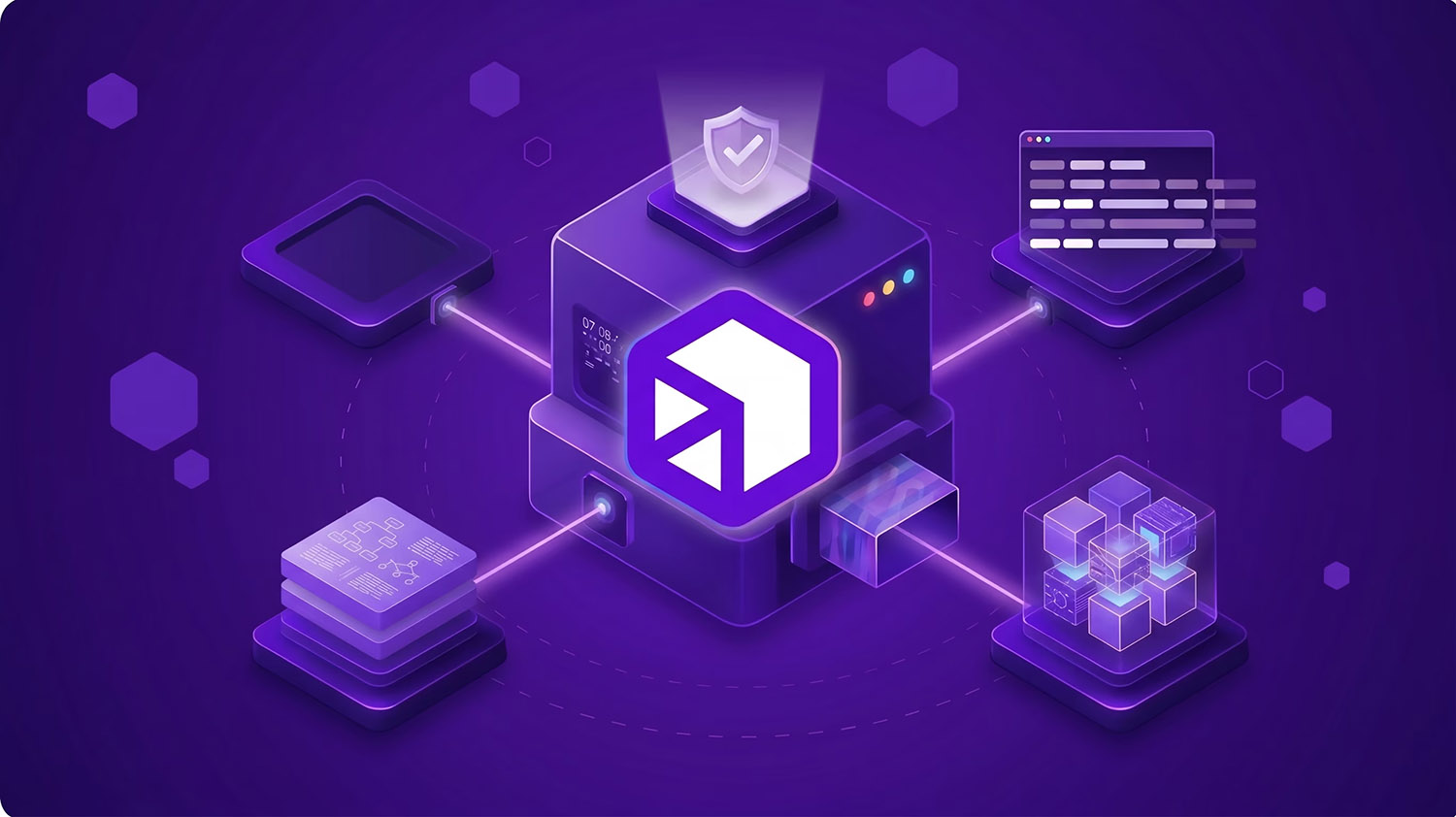
Low-code systems are development platforms that allow the creation of applications with minimal manual coding, using visual interfaces, ready-made components, and configurable logic. In many contexts, this reduces delivery time and accelerates automation and internal applications. In corporate environments, however, the real value lies not only in speed but also in the ability to integrate this layer with the rest of the architecture with governance, security, and predictability.
What does a low-code system mean in practice?
A low-code system is a platform used to develop applications with less reliance on manual programming. The base text defines this model precisely by explaining that, instead of writing many lines of code, construction happens through visual interfaces, draggable components, and ready-made functional blocks.
In practice, this means that a significant part of the development now takes place at a more visual level, with flows, forms, rules, and integrations being configured instead of being implemented from scratch. This model has gained traction because it addresses a real market need: delivering digital solutions faster, with less operational effort.
But this point needs to be approached with maturity. In companies, a low-code system shouldn't be evaluated solely as a productivity tool. It needs to be understood as part of the business architecture.
How do low-code systems work?
The submitted content shows that a low-code system typically allows you to build the application structure with graphical elements, integrate systems and databases, automate business processes, and more easily deploy the solution in the cloud or in local environments.
In practical terms, this means working with reusable components and configurable logic, instead of developing all the parts manually. This model can accelerate the creation of apps, internal workflows, automations, and digital solutions focused on operations.
But speed alone doesn't solve the bigger problem. In enterprise contexts, the crucial point is ensuring that the application built at this layer can connect to ERP, CRM, databases, legacy systems, and APIs without increasing operational fragmentation.
What is the difference between low-code and no-code?
The base text clearly differentiates between the two models. Low-code still allows, and in some cases requires, some technical knowledge for more complex customizations. No-code, on the other hand, aims to serve users without any programming experience.
This distinction matters because it shows the place of low-code within enterprise architecture. It doesn't automatically replace traditional development, nor should it be treated as a universal solution for every scenario. Low-code tends to make more sense when a company needs to balance speed with some degree of technical flexibility.
In other words, it occupies an intermediate space between fully manual development and completely no-code construction. It is precisely this position that makes it useful in many corporate contexts.
Important points
- Low-code systems allow you to create applications with minimal manual coding.
- The model uses visual interfaces, functional blocks, and configurable logic.
- The main goal is to accelerate development without starting from scratch.
- Low-code offers more flexibility than no-code in enterprise scenarios.
- In enterprise environments, integration and governance are just as important as speed.
- The real value depends on the ability to connect the low-code layer to the rest of the operation.
What benefits justify the adoption of low-code systems?
The text highlights benefits such as agility, cost reduction, increased productivity, ease of use, process automation, and scalability. These factors help explain why the model has gained so much attention.
In business terms, the most visible gain is the ability to shorten the distance between demand and delivery. This helps companies respond faster to internal needs, automate processes, and test new solutions with less initial effort.
However, in more critical operations, these benefits are only sustained when the low-code layer is part of a more coordinated architecture. Without well-structured integration, the company may accelerate application delivery, but continue to accumulate scattered data and disconnected flows.
Where are low-code systems typically used?
The core content showcases applications such as internal process automation, web and mobile application creation, integration between legacy and new systems, data management and reporting, as well as solutions focused on customer service and self-service.
These use cases make sense because they address common needs in the corporate environment: speed, repetitive tasks, multiple systems, and pressure for efficiency. Low-code is often useful when a company wants to accelerate this type of solution without starting an extensive traditional development project.
At Digibee, this point is approached with an additional layer of maturity. The challenge lies not only in building applications faster, but also in ensuring they are part of an enterprise integration strategy, connecting processes, data, and systems with greater predictability.
Read more
What are low-code systems?
These are development platforms that allow you to create applications with minimal manual coding, using visual interfaces and ready-made components.
Is low-code the same as no-code?
No. Low-code still allows for more technical flexibility, while no-code tends to cater to simpler and less customizable scenarios.
Do you need to know how to program to use low-code?
Not always. Many platforms significantly reduce the reliance on programming, although technical knowledge remains useful in more complex scenarios.
Is it possible to integrate legacy systems with low-code?
Yes. The source text shows that many platforms offer connectors and APIs for this type of integration.
Does low-code replace developers?
No. The model complements the technical work and helps free up teams to focus on more critical flows and systems.
Is it worth learning about low-code today?
Yes. The source text highlights that this is an increasingly valued skill, both by technology professionals and by business areas.
Why low-code systems need to be evaluated with an enterprise integration perspective.
Talking about low-code systems means talking about speed, accessibility, and productivity, but also about architectural responsibility. The base text demonstrates this by presenting low-code as a more agile way to develop applications, automate processes, and democratize the creation of digital solutions. This advancement is relevant because it addresses a real need for companies: to innovate with less time and less operational effort.
At Digibee, this issue needs to be addressed from an enterprise-level integration perspective. The value of low-code isn't just about enabling faster application development. It's about ensuring that these applications operate connected to the rest of the architecture, securely exchanging data, respecting business rules, and functioning with observability and governance in production. Without this, the company may gain initial speed, but it remains exposed to system and process fragmentation.
This point is especially important in organizations that coexist with cloud computing, APIs, legacy systems, and multiple critical workflows simultaneously. In this reality, low-code systems cannot be seen merely as visual development tools. They need to be part of a larger strategy capable of connecting modernization, integration, and architectural evolution more consistently.
This is what transforms low-code into a real asset for the business. It's not just about accelerating deliveries, but making that acceleration contribute to a more coordinated, secure operation, better prepared for growth.