Top 5 Enterprise Integration Pain Points That Inspire Change
Exploring the top five common integration pain points driving enterprises to make changes for successful outcomes.

PUBLISHED
January 25, 2024

Exploring the top five common integration pain points driving enterprises to make changes for successful outcomes.
Every Digibee customer journey starts with an impetus – a chronic pain point that drives the company to change how it integrates. Often these scenarios have measurable impacts to the business, impeding growth, profitability, the health, and ultimately, the success of the organization.
Click and Learn More
In this blog post we examine the different integration pain points that drive enterprises to our door. From legacy vendor lock-in to onerous system updates, every enterprise has an integration story. Here are the top five based on our customers’ experiences:
>> Book a personalized demo with our team of experts and see how Digibee’s iPaaS will bring efficiency to your business.
Prior to Digibee, the majority of our customers endured a rigid, monolithic legacy integration system for a shockingly long period of time. While it was understood that more modern alternatives existed, the cost of switching was incredibly high, requiring a significant commitment of time and resources.
Legacy Application or System: An information system that may be based on outdated technologies, but is critical to day-to-day operations. Replacing legacy applications and systems with systems based on new and different technologies is one of the information systems professional’s most significant challenges.
Gartner Glossary
While any transition to a new system requires effort, modernizing your integration strategy delivers one of the highest ROIs to your business. After all, contemporary integration platform-as-a-service (iPaaS) technology serves as the glue that connects all of your applications, for an agile and composable IT environment. With new AI-powered integration migration capabilities, Digibee customers evolve in record time.
The pain of legacy integration system upgrades is at or near the top of the list for most Digibee customers. These workflows consume time and people on an ongoing basis. The process also imposes system downtime and other disruptions to the business. It’s an expensive and never-ending cycle required to simply maintain the status quo.
According to Digibee’s XNUMX State of Enterprise Integration report, upgrading from legacy infrastructure ranked in the top ten integration objectives for enterprises in North America.
26.70 %
Of companies want to use iPaaS to upgrade legacy infrastructure
With Digibee’s modern iPaaS, every time a customer logs in, they access the most recent version of the technology, guaranteed. We maintain our born-in the cloud platform, with no investment of resources or time required by our customers. All bandwidth that was hijacked by legacy end-of-life workflows and system upgrades is repurposed for more important work.
Legacy integration systems and IT project backlogs are synonymous. With software developers investing the lion’s share of their time simply maintaining the existing system, special projects and innovation initiatives languish in the backlog, stymying innovation and the company’s ability to grow and prosper.
60%
Respondents reported that up to 60% of pending IT projects rely on integration support.
Another finding from the Digibee report shows that most respondents estimate that up to 60% of their IT project backlog relies on integration support.
Once on board, Digibee customers conquer IT backlogs in record time, freeing up bandwidth and budget to invest in innovation.
Enterprises saddled with a legacy integration product often have to invest heavily in ongoing training and certification for the development team. Limited by budget, most companies choose to train a subset of developers, enabling just a portion of the team to do the work.
Maintaining such a specialized team also increases the costs of hiring and retaining talent, as we showed in a recent article comparing the requirements of legacy MuleSoft with the Digibee integration platform.
Given the popularity of APIs, it is no surprise that API calls account for 83% of Internet traffic, an astounding statistic. Unfortunately, for those enterprises reliant upon legacy integration systems, the underlying structure of custom coding and point-to-point integrations is impossible to track. As a result, integration teams invest a lot of time mapping old code and rebuilding integrations.
The number of business technology applications used within companies now exceeds 1,000. However, integration between these apps is in short supply. Less than 30% of these are integrated.
Forbes: Beware Of the ‘Frankenstein Stack’ Of Data Systems
Digibee customers use a much simpler process, leveraging our low-code visual interface and seamless workflows to enable rapid API creation, once again liberating the integration team from manual and time-consuming work. Digibee abstracts away the complexity of integrating APIs, so your API strategy isn’t constrained. Read the blog post: Pros and Cons of APIs and How iPaaS Helps for more information.
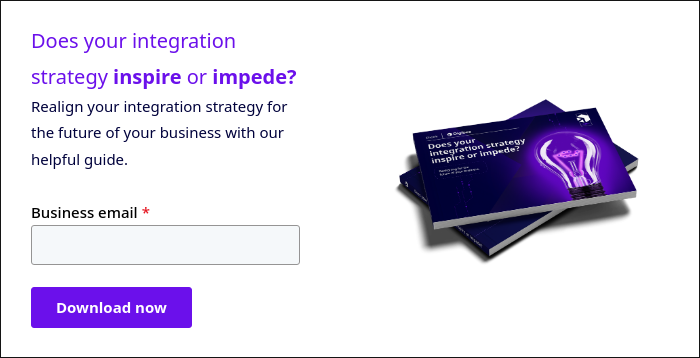
Odds are your company’s story is reflected in at least one of these pain points. If so, we welcome you to download a free copy of the Digibee whitepaper: Does your enterprise integration strategy inspire or impede? A detailed examination of the savings and efficiencies businesses achieve with modern integration technology.
For more information, visit our website or, if you prefer, contact us to arrange for a live demonstration on Digibee in action.
Rodrigo cofounded Digibee based on the principles of simplicity, agility and strong human connections — with the goal of freeing less technically savvy customers from their reliance on developers for more rapid, cost-effective digital transformations. After receiving a Bachelor in Computer Science and an MBA, Rodrigo went on to senior roles at CA Technologies and Zup Innovation.
RECOMMENDED POSTS
An AI engineer explains some of what he had to do to build the Digibee Digital Worker.

AI will not replace deterministic workflows in financial services. It complements them with reasoning and context capabilities where rules alone are not enough.

What differentiates an AI-native platform from an AI-powered one? A platform rebuilt for agents, with specialized workflows and collaboration between people and AI.