Guide: AI for Enterprise Integration

PUBLISHED
September 9, 2026
When it’s the smart solution, when it isn't, and what "AI-Native" integration actually means
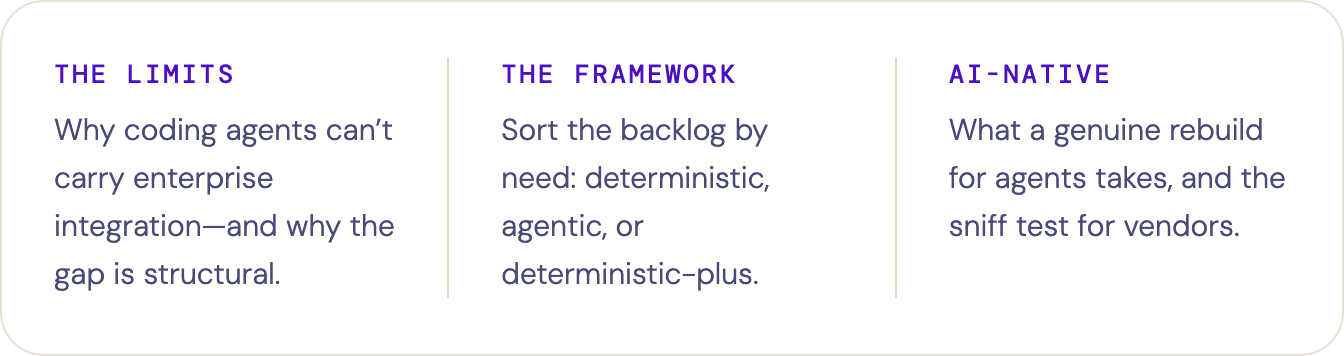
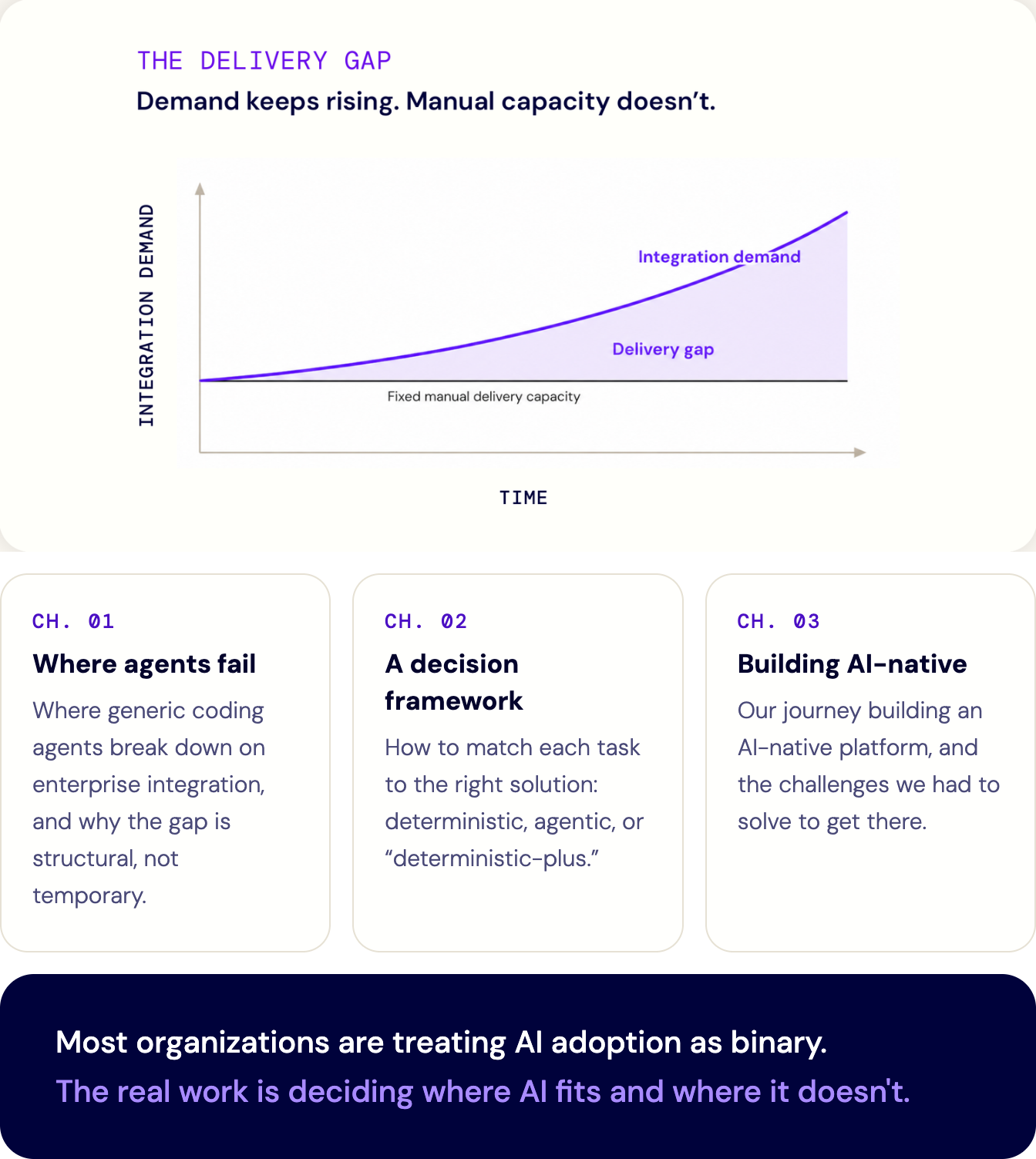
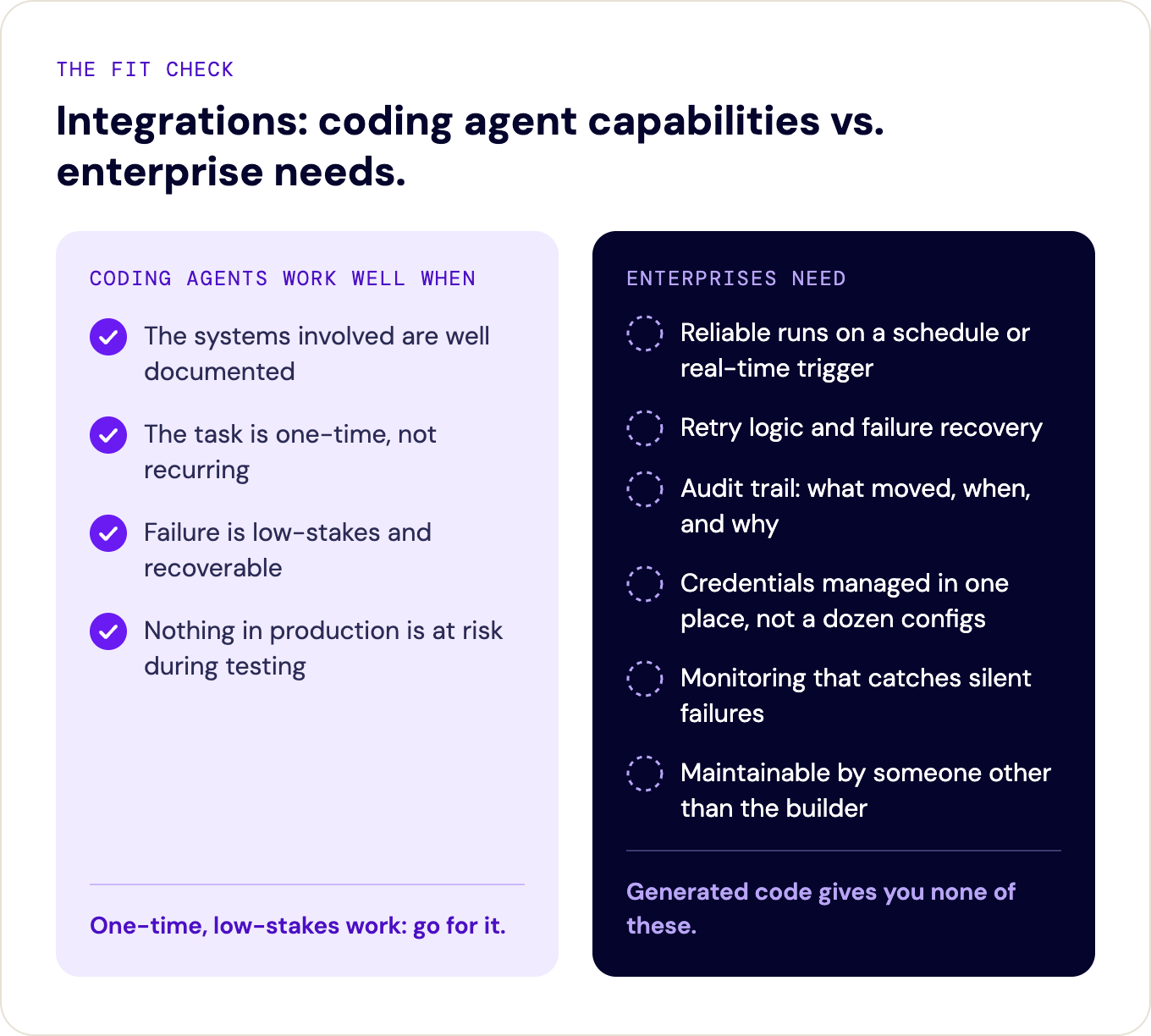
Coding agents like Claude Code are good at throwaway integration work: one-time migrations, well-documented systems, low-stakes scripts. They fall apart on enterprise integration necessities: scheduled runs, retry logic, audit trails, credential management, monitoring that catches silent failures. The gap isn’t a maturity problem that better models will fix. It’s structural. When a model hits its “lost in the middle” limit on a long context window, it falls back on training data and produces code that passes tests and fails quietly in production, sometimes six months later.
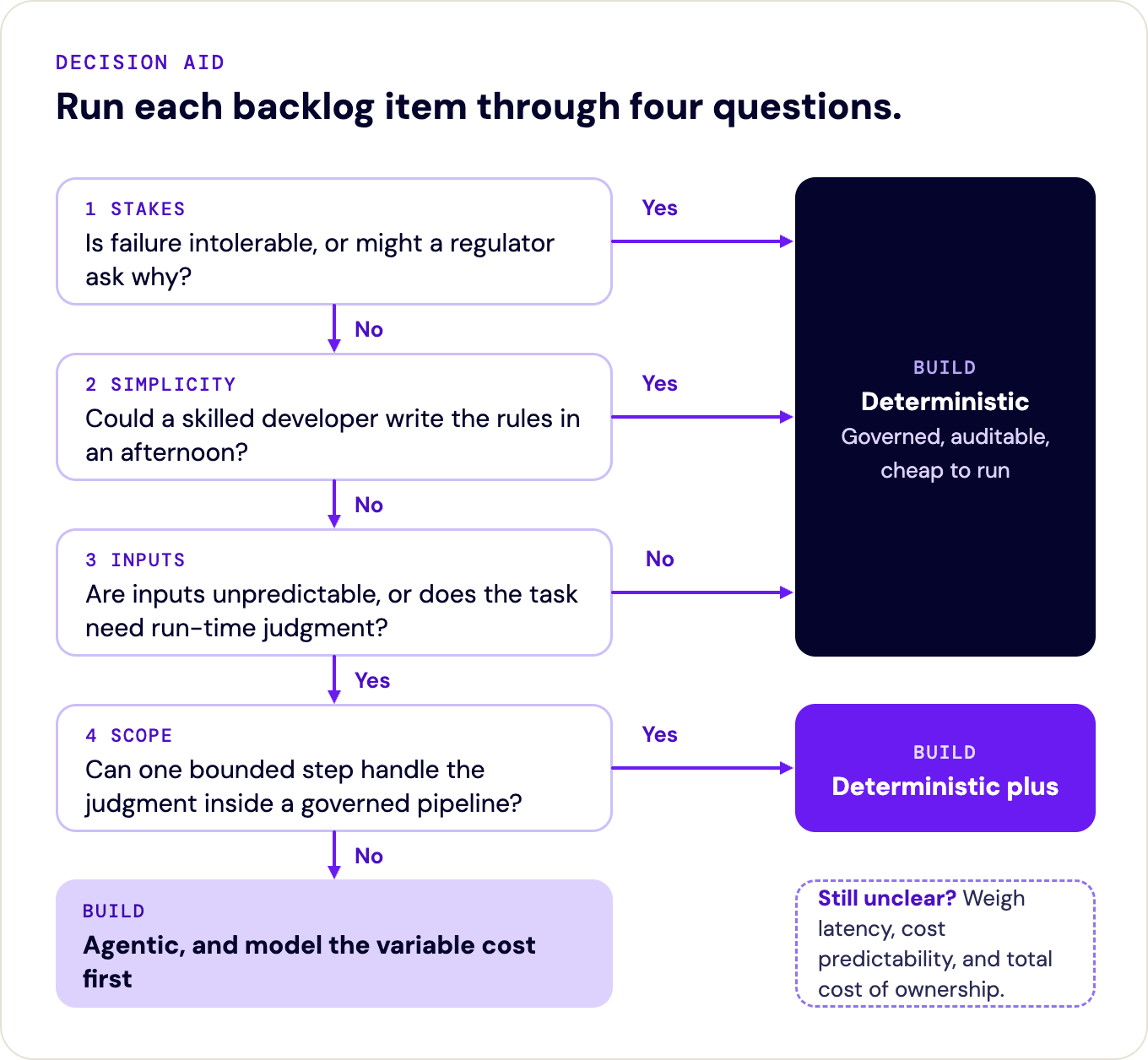
We present a decision framework for sorting backlog items by what they actually need, not by which tool is trendiest. Deterministic logic wins when failure has zero tolerance, when a regulator might ask for an audit trail, or when a competent developer could write the rules in an afternoon. Agentic AI earns its place when inputs are unpredictable or the task needs judgment a rule set can’t encode. Most work falls in between: a “deterministic-plus” pattern where a governed pipeline does the heavy lifting and an LLM handles one bounded step, like flagging an invoice exception or triaging a helpdesk ticket. Most of the backlog still belongs on the deterministic end. Adding AI to something that isn’t broken doesn’t make it better; it makes it harder to govern.
In the last section, we explore what Digibee built to be “AI-native.” This included building a new UI specifically for agents, and injecting integration knowledge into specialized agents. We also offer a sniff test: ask any integration vendor whether they rebuilt for agents or just added a chatbot.
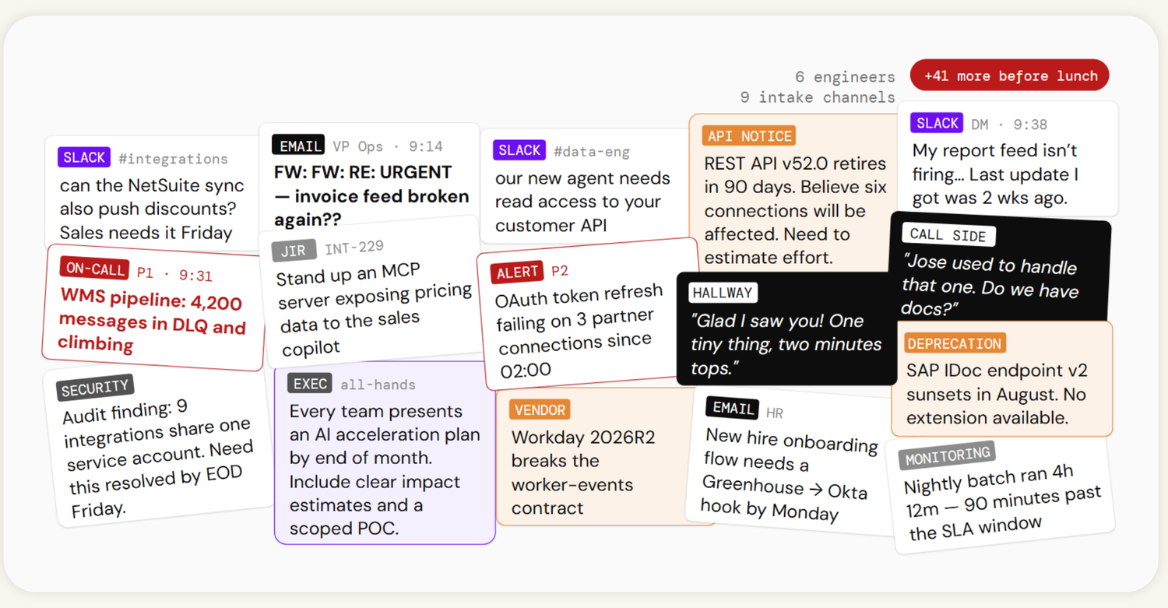
Boards, CEOs, and your C-suite peers are pushing AI-first mandates, and stakeholders believe agents can solve any software problem. The flood of AI initiatives keeps expanding the integration backlog, and the integration team can’t keep up.
Integration specialists have been handed generic AI tools designed for greenfield software development and told to move faster. In integration settings, those tools offer little help. In this guide, we examine the tension between integration and AI in three parts.
Every team at Digibee uses Claude Code. We want to start there, because what follows is not a dismissal from people unfamiliar with the tools.
Coding agents have changed how our engineers work, how fast we prototype, and how much cognitive load we save on routine tasks. If your teams aren’t using them, you’re leaving real productivity on the table. But their success in greenfield development created an assumption that they can be pointed at any software problem. Enterprise integration is a different category of work, with different failure modes that coding agents weren't designed to handle.
Generic coding agents handle integrations well under specific conditions:
A one-time migration from a REST API to a CSV? Go for it. A quick script to pull data from a public endpoint? Perfect. A throwaway ETL task with no downstream dependencies? Good use of the tool. The problems start the moment the integration faces more complex conditions.
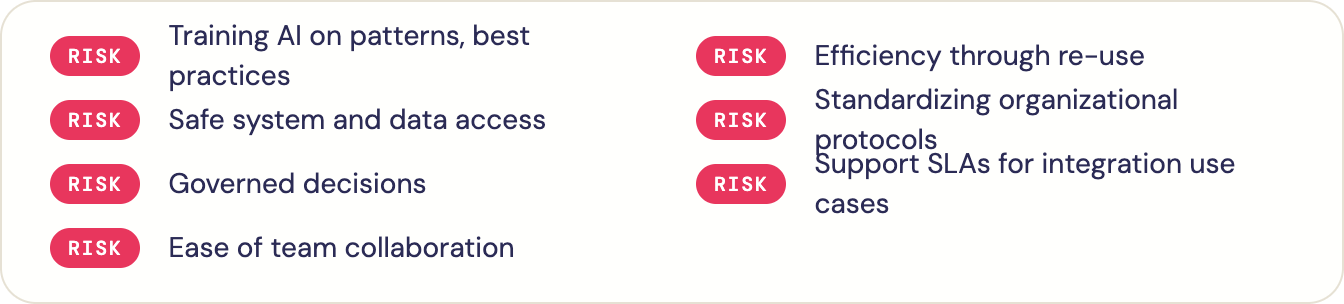
Coding agents don’t produce any of this. They produce code—code that has to live somewhere, be secured somehow, and be maintained by someone. Falling short on this can create expensive process or compliance failures.
It’s tempting to frame this as a maturity argument: coding agents are new and will improve. But the limitations are structural, not incidental. Enterprise integration depends on accumulated knowledge encoded in pre-built connectors that account for how NetSuite sequences operations, how SAP handles idempotency, or how Salesforce structures its data model. A coding agent reasons about each of those nuances from scratch, every time. That’s where subtle, production-only bugs are born.
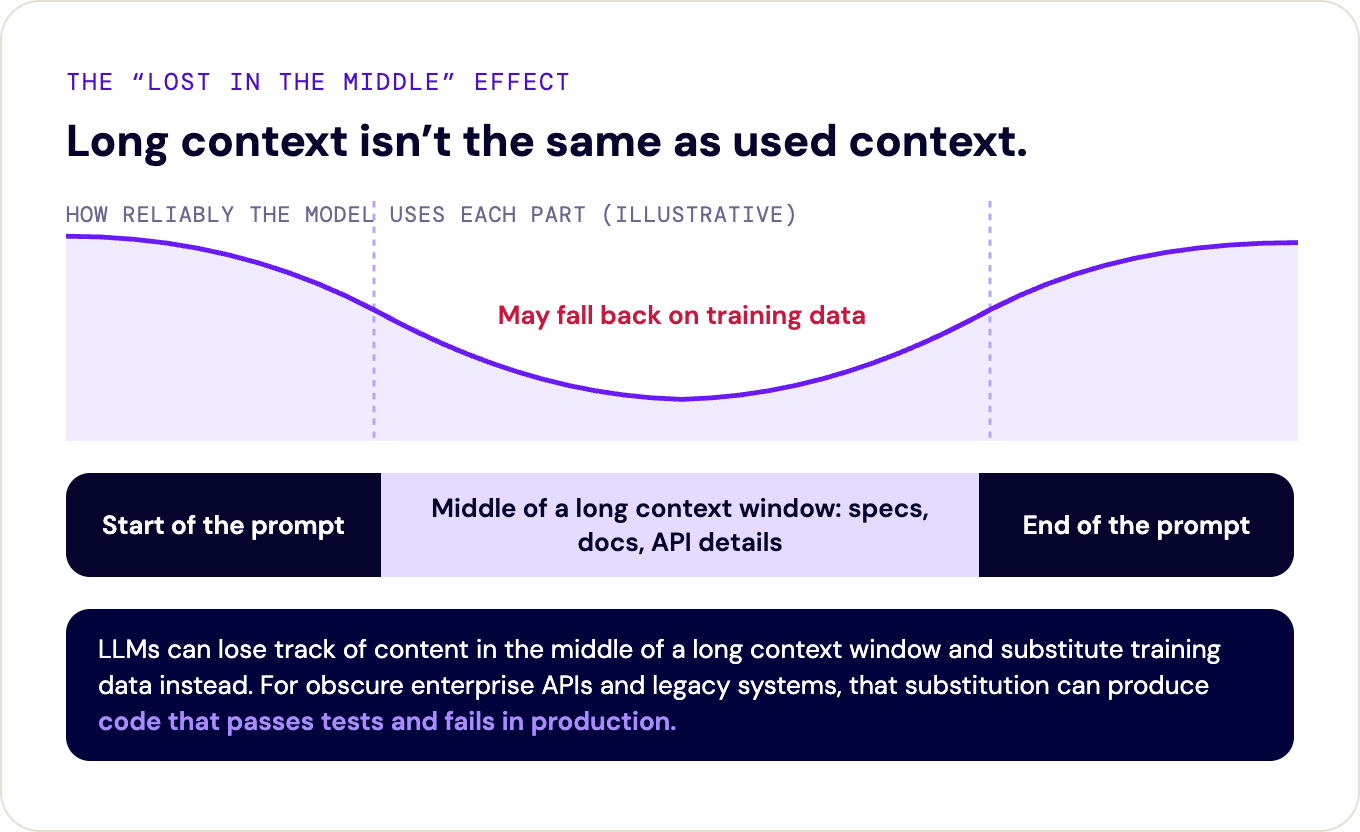
Enterprise integration targets are often poorly documented. That's the reality of legacy systems, accumulated data contracts, and decades of organizational complexity. Most of the behavior that matters only surfaces under load, and none of it is in the spec. Even when documentation exists, an agent may ignore it. Researchers have found that LLMs can lose track of content in the middle of a long context window—an effect sometimes called "lost in the middle." When that happens, the model falls back on its training data. The more obscure the package or API, the more likely the agent is to generate code that fails against it.
Agents don't improve on this automatically. They don't accumulate understanding across sessions. Agents parse complex sequencing logic and non-obvious idempotency rules anew each time. The code they produce is bespoke, hard to read, and difficult to govern consistently across an enterprise estate.
The worst outcome: bugs that don’t break loudly on deployment. They silently corrupt records or double-write transactions in edge cases that only surface under real load. The CIO learns about them six months later.
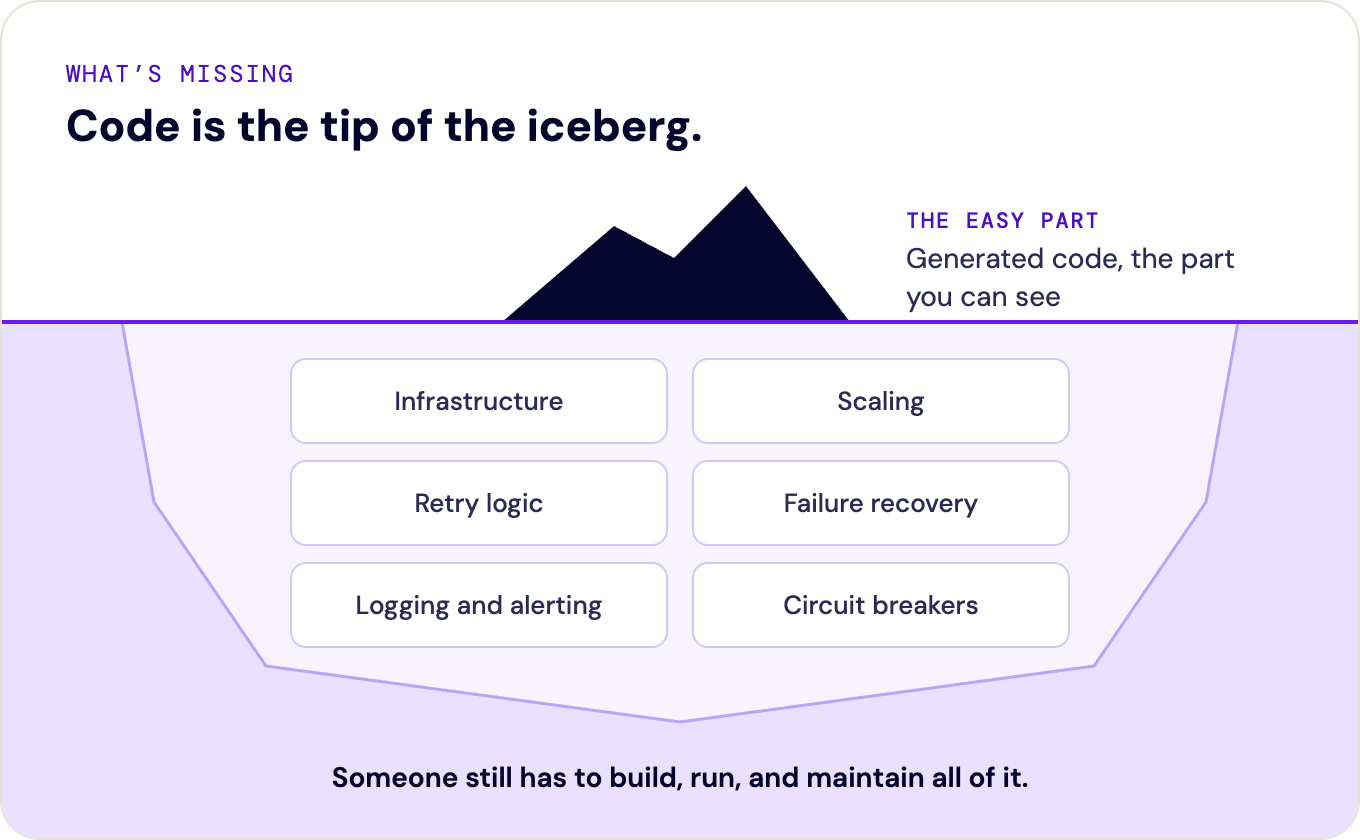
Someone has to provision infrastructure, manage uptime, handle scaling, implement retry logic, build failure recovery, and create visibility into what happens in production.
You could prompt your way around each gap individually. But now you’re building an integration plus everything required to run it, each with its own maintenance burden.
Coding agents are also optimized to iterate fast, not to fail safely. When an integration fails in production, payments aren't processed, freight bids aren't made, or orders don't ship. An agent that generates business logic without logging, alerting, or circuit breakers gives you half a solution—the easy half.
APIs change. Tokens expire. Systems update. An agent has no relationship with what it built and no memory of why decisions were made. The integration lives in the head of whoever prompted it. When that person leaves (even for vacation) so does the rationale behind every design choice.
Technical debt is visible. Governance debt isn’t—until it’s a breach, an audit finding, or someone’s last day.
Generic coding agents generate code directly from a prompt. There’s no intermediate artifact—no specification, no mapping document, no structured record of requirements, edge cases, or error behavior. That’s a control gap, and it affects any team that needs to understand, audit, or change an integration after the fact.
Any integration that moves data between systems needs a reliable record of what moved, when, and why. Generated code doesn’t produce it.
API keys, OAuth tokens, and service credentials need to be stored, scoped, and rotated correctly. Generated code has no opinion on this and no ownership over it. Every custom integration becomes a new artifact to secure, a new attack surface, and a new dependency with no ownership model.
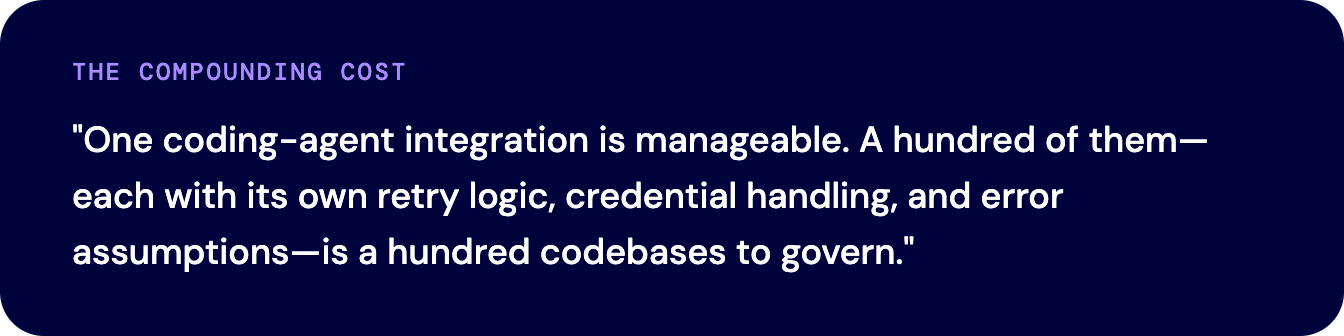
A hundred integrations, each with its own retry semantics, its own error handling, its own credential assumptions, are a hundred codebases to secure, update, and maintain.

Teams using Claude Code often rely on “skills”—embedded example libraries and documented patterns that improve an agent’s output on well-defined tasks. Applying skills to integration would mean researching how each target system behaves beyond its documentation: edge cases, rate limits, version-specific quirks. That’s not one-time work; enterprise systems change, and any skill would need to evolve alongside them.
Even well-crafted skills don’t eliminate the risk of buggy code. LLMs behave probabilistically. They might produce perfect code for one prompt; for the next, their output might pass tests and fail silently in production. Idempotency violations don’t throw errors. Double-writes accumulate until reconciliation breaks several days later.
A skill can document how to respond to a failure, but it can’t notice one. The agent doesn’t run alongside the integration. A platform does: monitoring for silent failures, alerting before reconciliation breaks, and keeping the operational layer running between builds.
Coding agents fall short on recurring, high-stakes, enterprise-scale integration. Not because the technology isn’t impressive, but because the problem doesn’t fit the tool. Knowing that, the question becomes: when does AI belong in integration at all, and when doesn’t it?
How to anchor to outcomes—not solutions—when solving enterprise integration challenges. You have a year’s worth of work in the backlog. How do you match each problem to the right solution?
You have a year's worth of work in the backlog, you're racing to validate where AI fits, and you face real system, team, and data constraints.
How do you match each problem to the right solution?
Work through the backlog item by item. Some tasks fit deterministic workflows, where AI would only introduce risk, cost, and delay. Others present genuinely ambiguous problems where agentic AI unlocks automation that wasn’t previously possible. A surprising number fall in between. It’s natural to bias toward a preferred platform, language, or the latest technique. Ask first what success requires for the process.
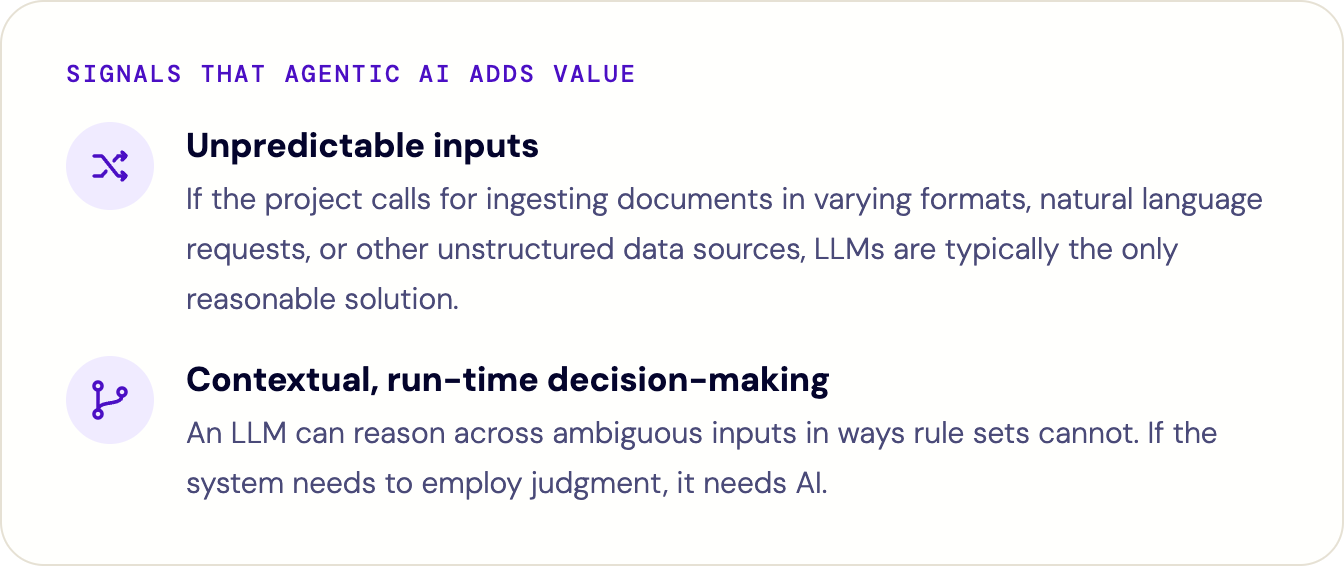
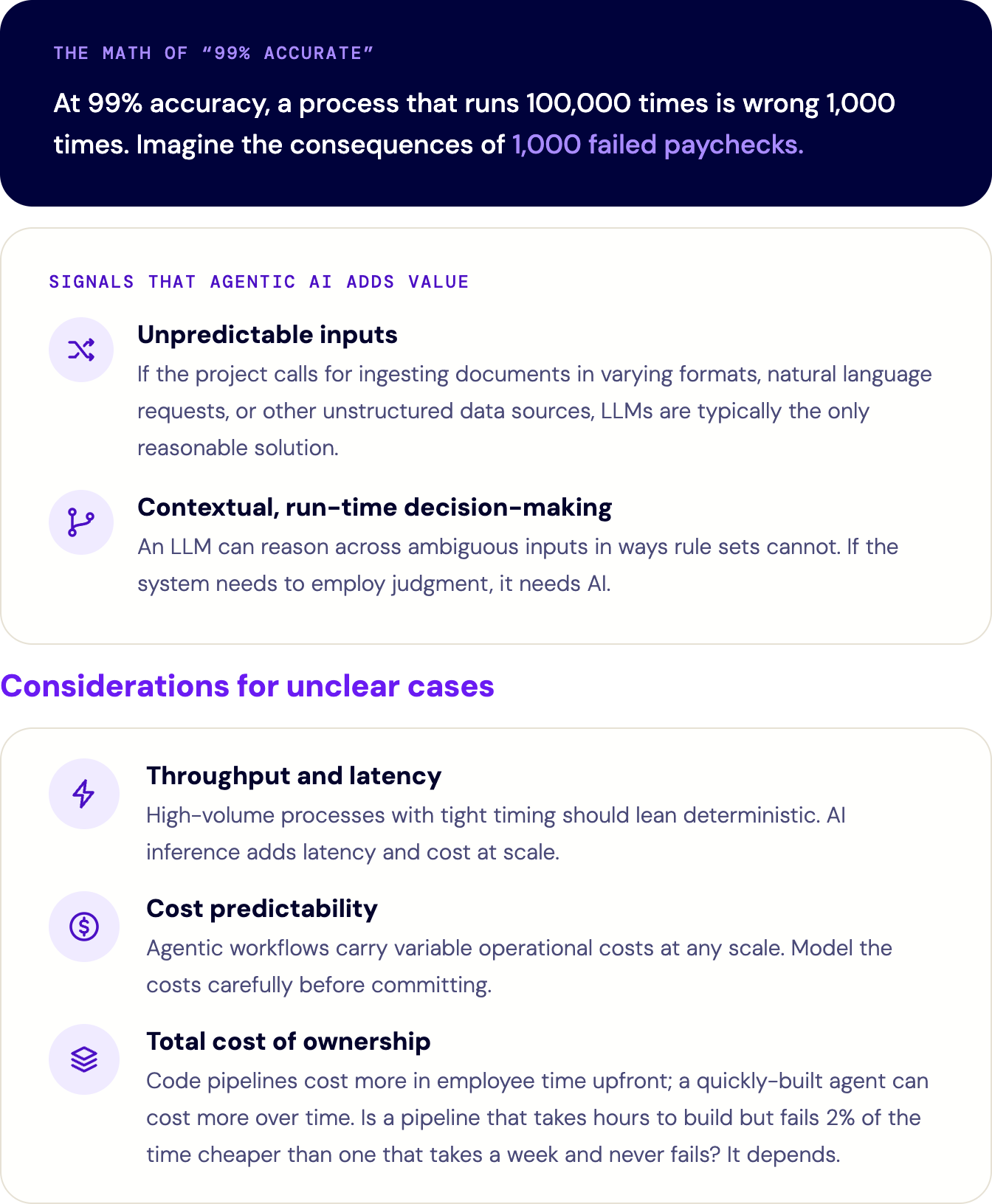
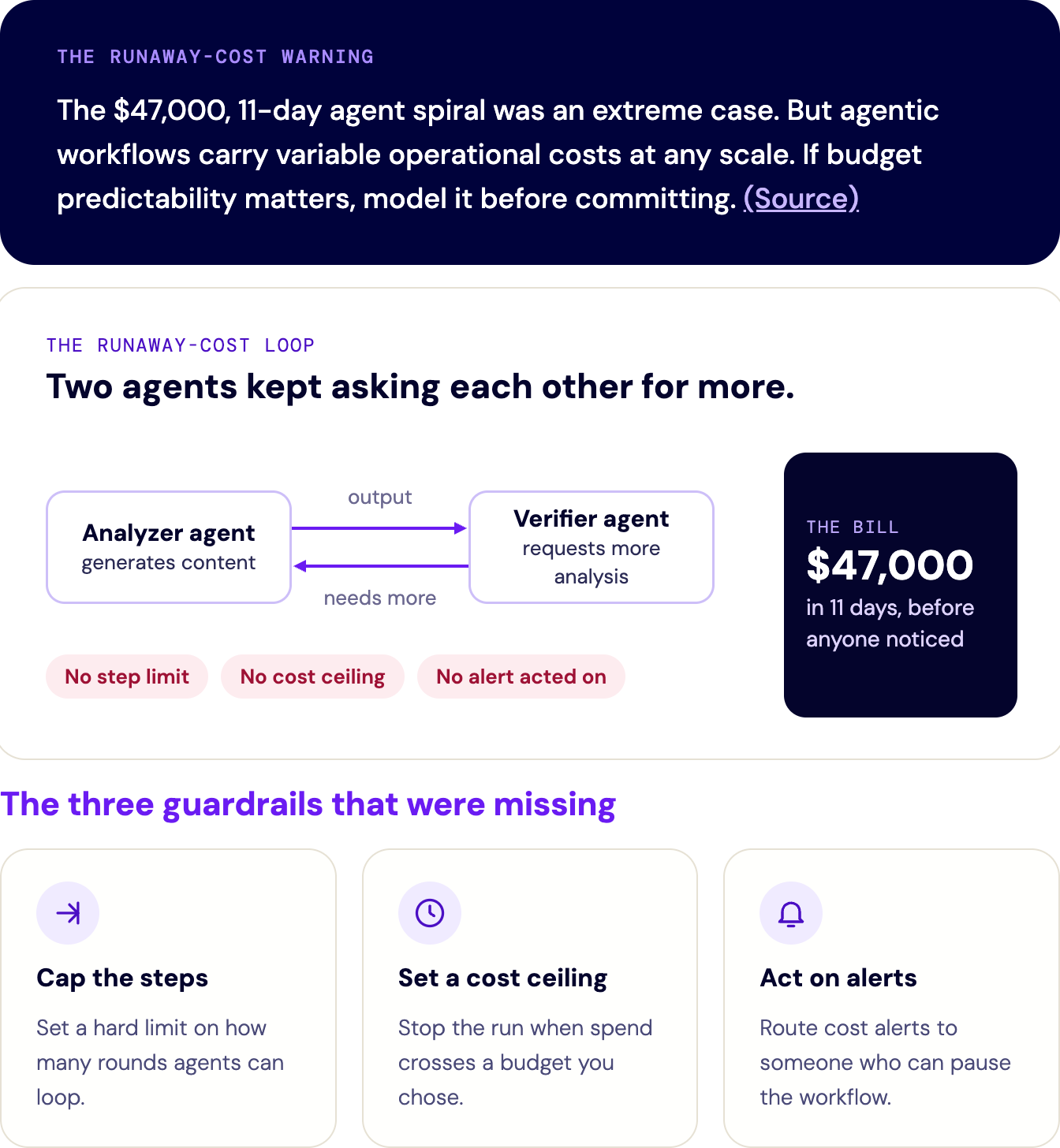
Today, most organizations we work with find the majority of their backlog belongs at or near the deterministic end. That’s appropriate; these are proven, solved integration goals. Agentic workflows open up new automation opportunities, and our customers are increasingly finding ways to add agentic value to deterministic pipelines without compromising the core.
Explore how Digibee has rebuilt its platform to enable both integration professionals and AI, shifting the human role to defining business outcomes, collaborating with AI (specialized Digibee Digital Workers) to create full specifications, and delegate the build.
With the right foundation, integration teams can address growing demand while maintaining the governance, monitoring and operational resilience enterprise systems require.
Before combining them, it’s worth being precise about what each end of the spectrum does well—and where each one costs you.
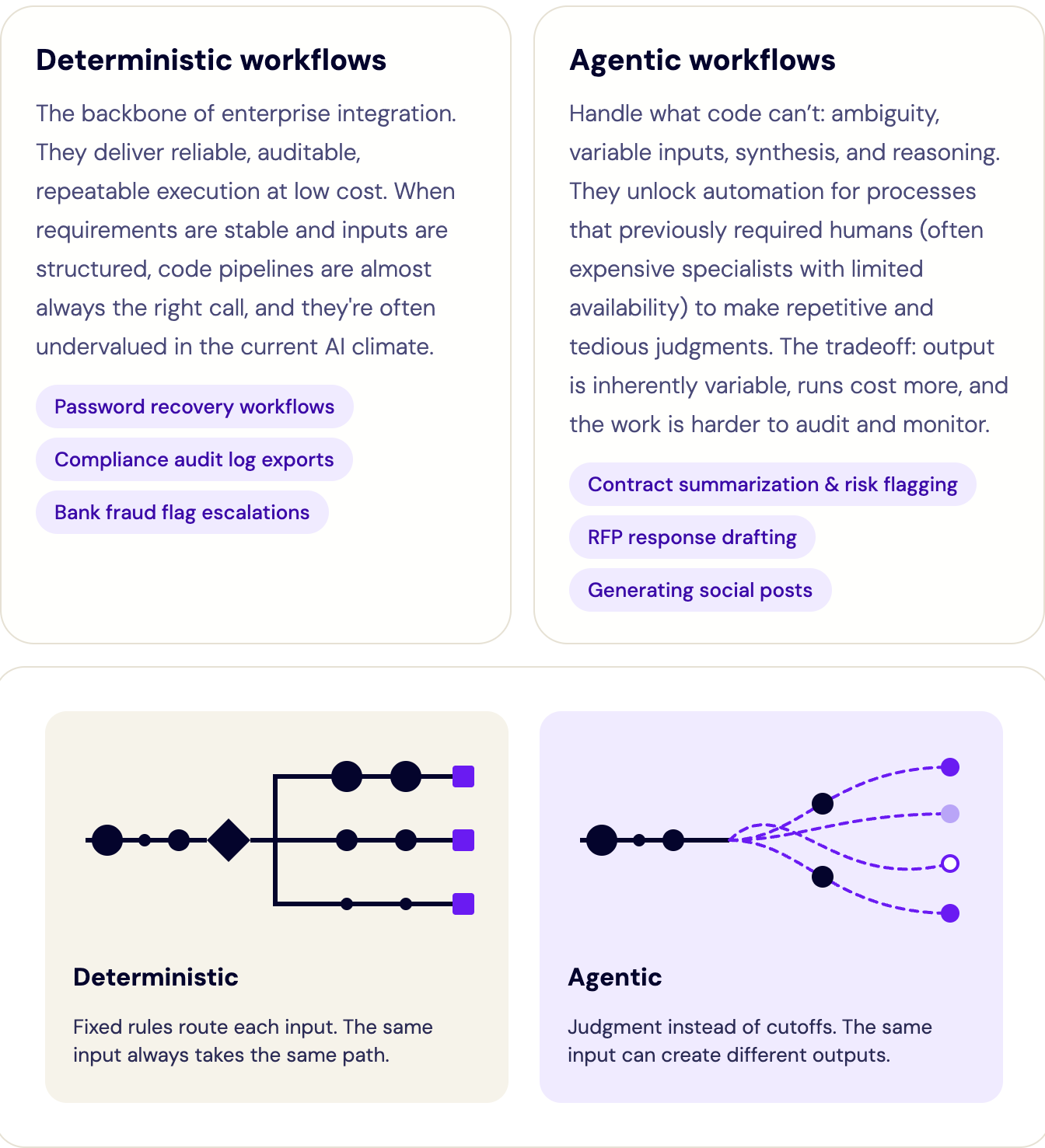
Most integration workflows should start as deterministic pipelines. “Deterministic plus” describes what happens when you enhance a proven, governed workflow by adding one or more agentic steps that deliver clear, bounded value.
This isn’t a 50/50 split. The deterministic pipeline remains the backbone; the agentic step adds targeted value.
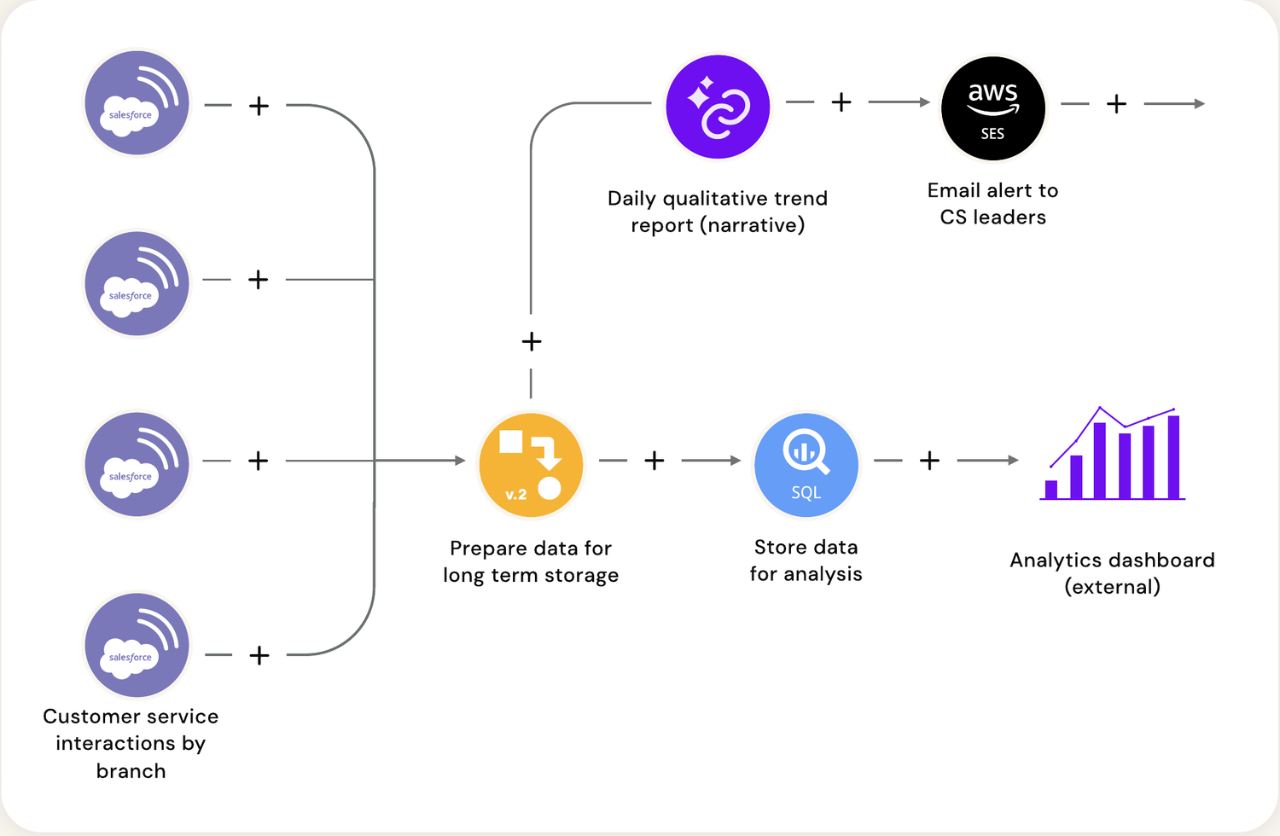
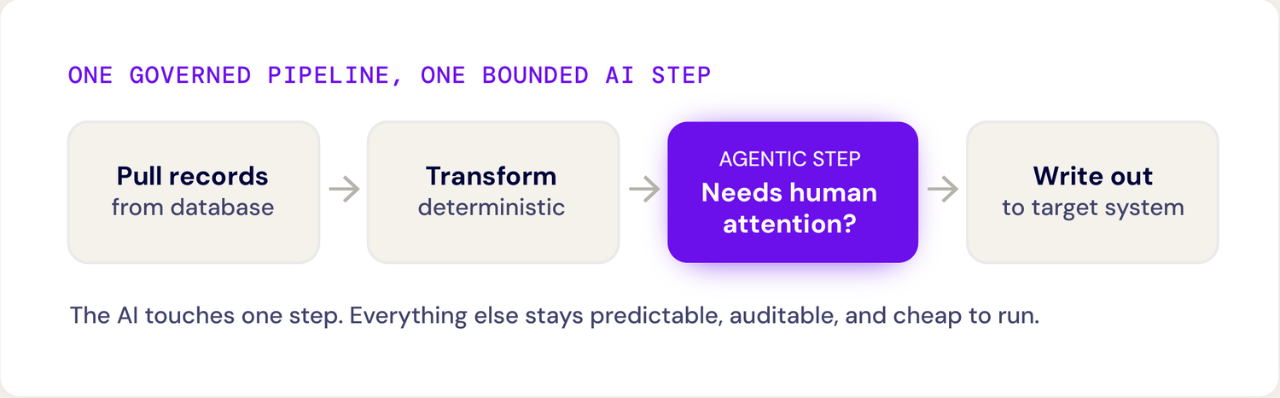
A fully deterministic pipeline ingests or moves a batch of data, then triggers an agentic workflow to analyze the batch for insights. One of our customers is experimenting with a centralized evaluation workflow to assess the performance of others across its integration estate. The integration logic stays clean; AI operates only where variability is acceptable.
Deterministic plus lets organizations capture AI value without exposing critical infrastructure to agentic failure modes. It’s also how most integration estates will actually evolve—incrementally, deliberately, and with governance intact. This pattern is what Digibee’s architecture is built to support.
The most capable integration leaders aren’t doing the most with AI. They’re the ones who understand the tradeoffs. If a deterministic workflow isn’t broken, don’t fix it. The backlog doesn’t need to be an AI backlog. It needs to be a solved backlog.
A year ago, we asked ourselves a simple question: how would we build our platform if we started from zero today? Here’s what we built and the reasoning behind it.
We founded Digibee to take full advantage of cloud technology when it was changing what was possible for B2B software. Most legacy iPaaS platforms marketed themselves as cloud-native while still running lift-and-shift workloads. Our customers have seen and felt that difference ever since. We won’t accept anything less in the AI era.
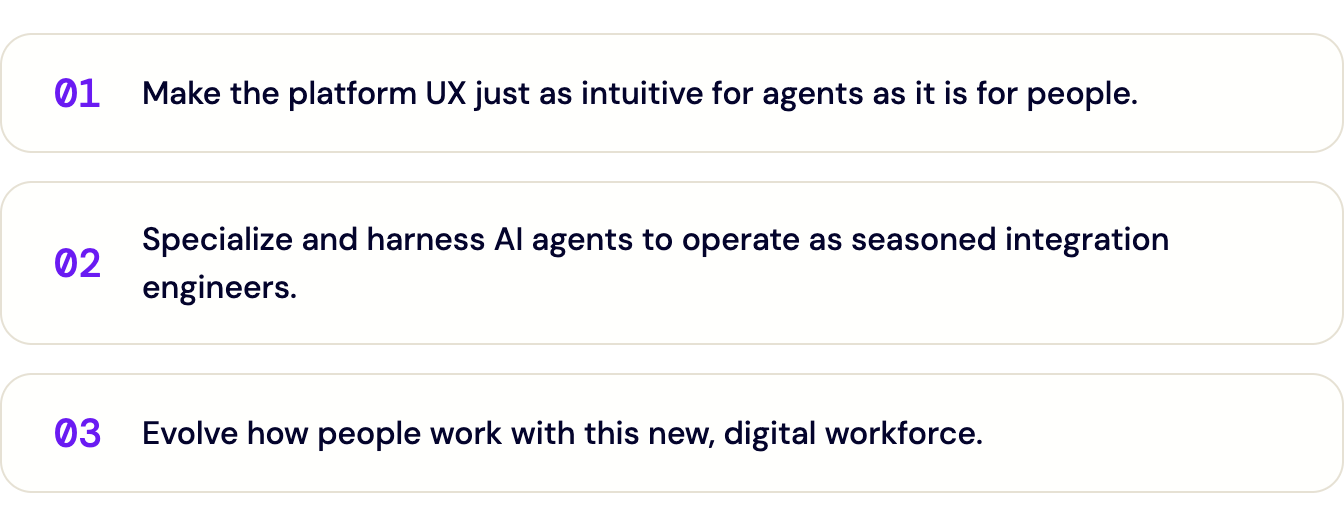
We reassessed Digibee from first principles. Our goal has always been for integration professionals to build enterprise-grade workflows (complete with credential management, security, and auto-scaling cloud infrastructure) as fast as available technology allows. With agentic AI, work shifts from execution to delegation and strategy. Making that real meant solving three challenges:
Humans need visual UIs: menus, buttons, form fields. AI needs atomized, self-explained interaction points. Given multiple ambiguous endpoint names, an LLM will confidently pick one and proceed. So we created APIs and MCP tools documented with clear, self-contained language, written for a reader that has no surrounding context to fall back on.
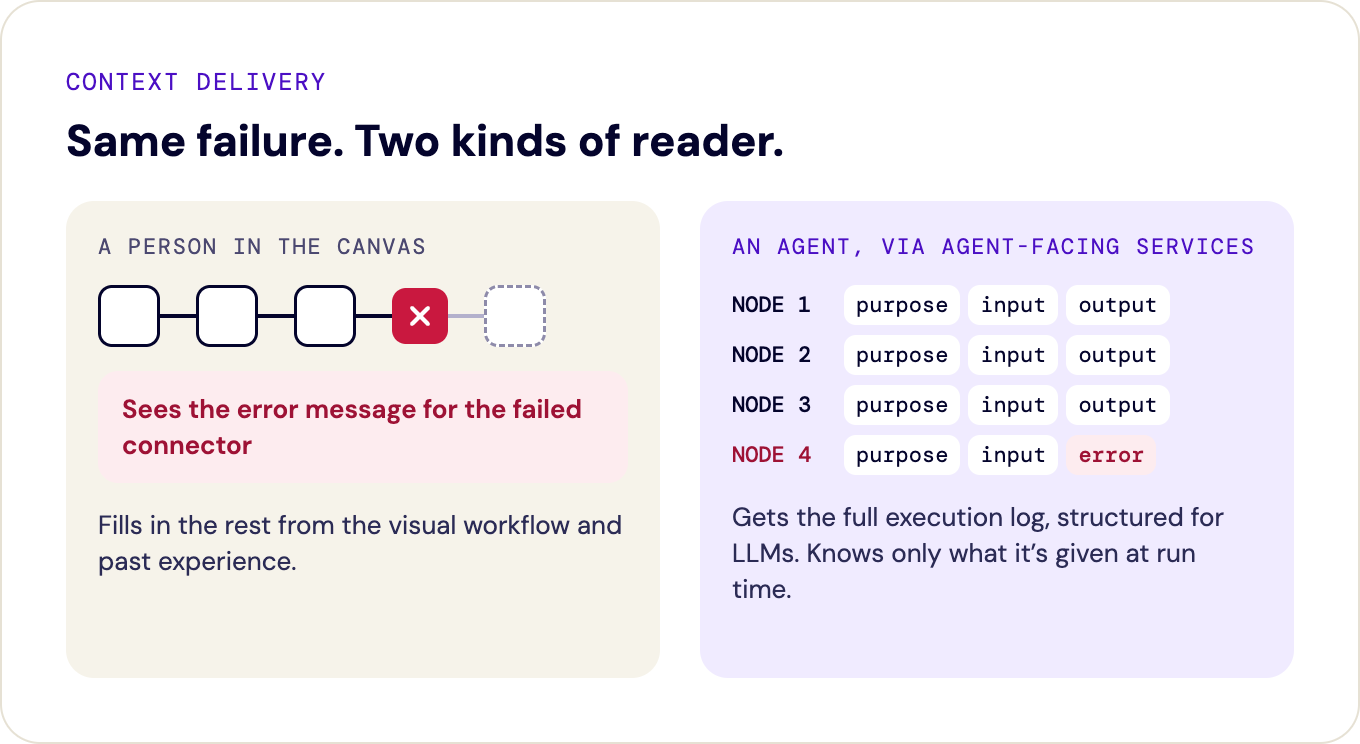
When users build in Digibee’s canvas, the platform surfaces the error message for the connector that failed. We could supply the entire execution log, but chose not to. Users don’t need it, and the full log would slow their search for relevant information.
LLMs benefit from processing the entire execution log. An agent doesn't necessarily understand what each node before the failure was supposed to do, and the additional context helps. Human users accumulate context through many vectors—the visual representation of the workflow, their experience with similar integrations. Agents gather context only from what they're given at run time. We built our agent-facing services to deliver deep context structured for LLM-friendly consumption.
Coding agents excel at work within a codebase. Integration work exists at the level of organizational knowledge. The systems integrations touch are frequently undocumented, and LLM training data includes very few examples of how to wire together obscure legacy systems. Digibee encodes integration logic into a “flowspec” document, and we’d be surprised if any major LLM’s training data has seen more than a handful of these.
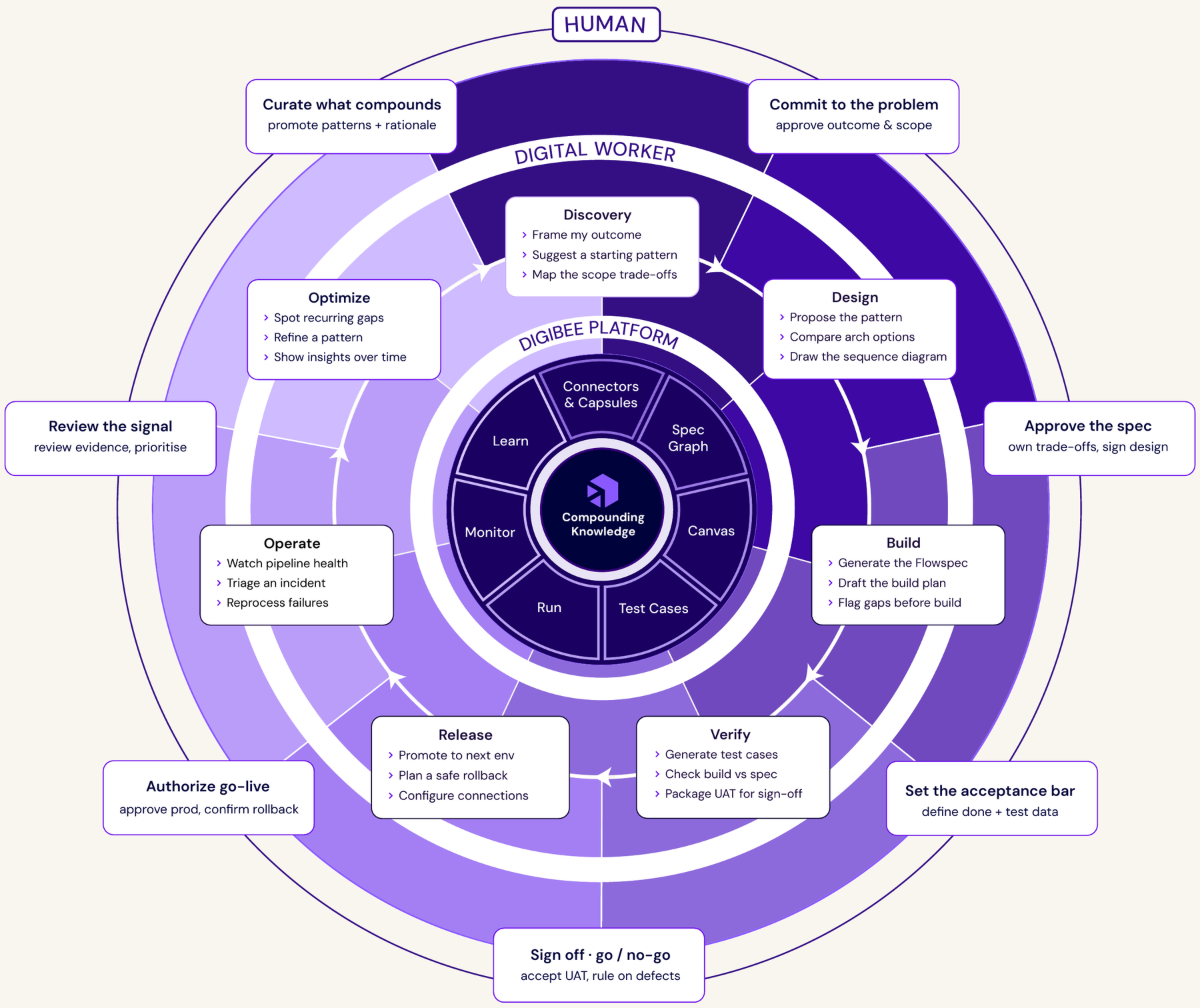
Building a workflow requires many divergent sub-tasks. Forcing one agent to handle all of them undermines results—the context grows too long, and the agent loses coherence. We distilled our knowledge into discrete prompt templates and distributed them to specialized sub-agents that deliver expert-grade output. The user sees none of this. They interact with one primary digital worker, who synthesizes the sub-agents’ output into a cohesive end-to-end project.
Our approach uses AI to draft projects and workflows, but in collaboration with the user. Users define and guide the project, then verify the output. The integration specialist’s job doesn’t go away; it changes. Achieving this required interfaces for two tasks: defining the integration specification, and reviewing what the digital worker built.
Checking output was straightforward; we already have the Digibee canvas. For collaborative planning, we built a new interface pairing a chat window with a multi-tab living document. Users begin by describing their high-level goal, then collaborate with the digital worker to craft a detailed project specification, complete with edge cases, trigger conditions, and error handling.
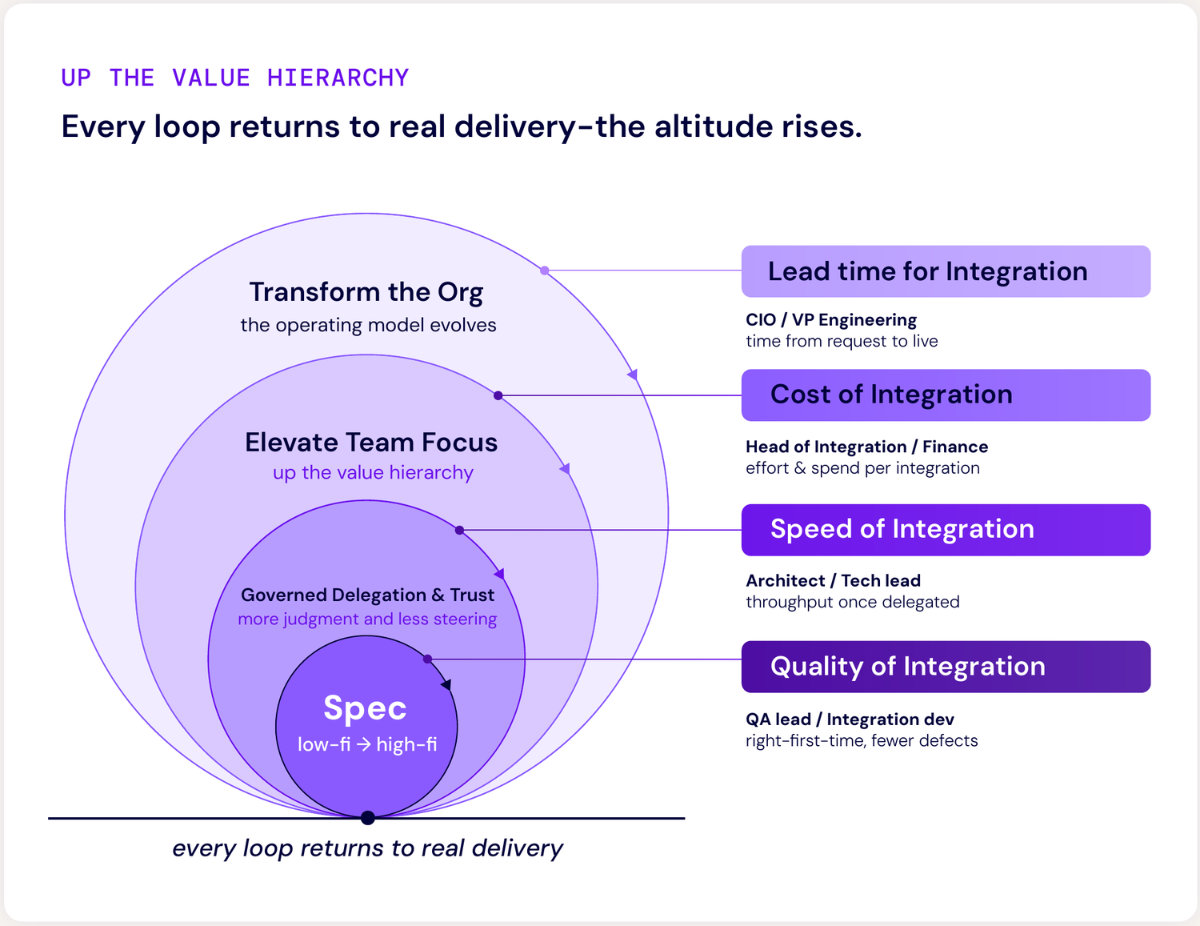
For Digibee’s users, AI-native means working at a higher altitude. While they review and adjust the digital worker’s output in the canvas, they no longer drag-and-drop every component. Clearing the backlog faster frees integration specialists to think strategically: what processes can we centralize into reusable capsules? Where haven’t we looked for business impact yet? These are questions integration teams have historically never had time for.

“Lift-and-shift” was the tell for cloud-washing. It moved old applications to the cloud without changing how they worked and didn't take advantage of what the cloud could do differently.
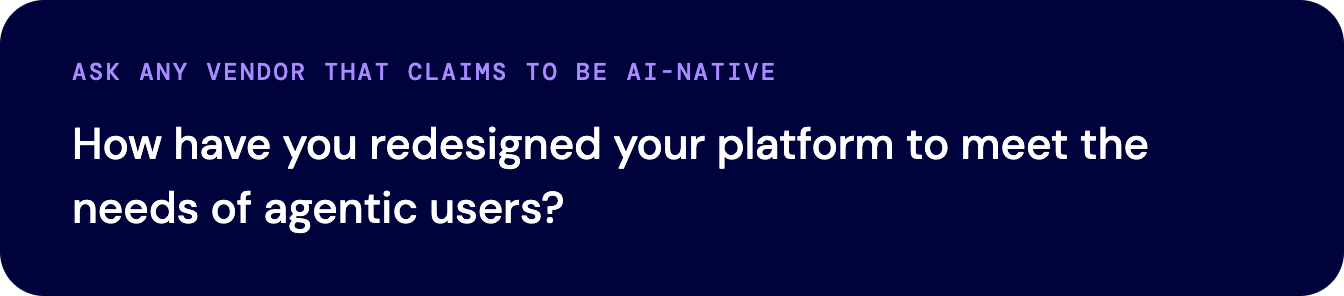
The AI-native equivalent is simpler: ask any vendor how they redesigned their platform for agents.
Adding AI onto existing products creates the same problems lift-and-shift did. It locks you out of what a genuine rebuild makes possible and keeps you in an intermediate state longer than you’d expect.
Ask the same question of your own workflows. You may find that the biggest gains don’t come from accelerating existing workflows. They come from asking which of those workflows should exist in their current form at all.
Digibee is the first AI-native enterprise integration platform. If you’re responsible for integration infrastructure and want to see what this looks like in practice, we’d like to show you.
Matt Casey
Matt Casey, Senior Product Marketing Manager at Digibee, creates blog posts, videos, e-books, and other content about enterprise technology. Before moving into product marketing, Matt built data products as a data scientist and produced stories for magazines, newspapers, and radio stations. In his spare time, he plays board games, parents two sons, and builds the occasional AI side project.