Retail Digital Transformation in 2023: High and in the Cloud
Where does your retail business stand on digital transformation? Learn how retailers are delivering amazing customer experiences with enterprise iPaaS.

PUBLISHED
January 19, 2023

Where does your retail business stand on digital transformation? Learn how retailers are delivering amazing customer experiences with enterprise iPaaS.
The cloud, combined with digital technologies, has reinvented the way retailers connect with and serve their customers. Once the domain of megastores and e-commerce platforms with the budget and resources to support on-premises infrastructure, today the cloud is unlocking digital customer experiences for retailers of all shapes and sizes.
And merchants are loving it, able to create personalized, curated experiences across multiple channels while increasing conversion rates and average order value (AOV). But it wasn’t always this way.
>> Book a personalized demo with our team of experts and see how Digibee’s iPaaS will bring efficiency to your business.
The advent of electronic commerce dates back to the 1960s, when IBM launched its online transaction processing (OLTP) system to process financial transactions in real time.
The technology was used in the development of a computerized airline reservation system for American Airlines called the Semi-Automatic Business Research Environment (SABRE).
The system connected computers in different agencies to a large IBM mainframe computer for simultaneous processing of transactions, with all agents accessing the same information at the same time.

*Photo credit: IBM Icons of Progress
A infrastructure cost $40 million to develop and install, the equivalent of more than $402 million in 2022.
Online shopping as we know it today didn't come about until the advent of the internet, with the first secure retail transaction over the web taking place in 1994. Amazon jumped on board the following year, launching its online shopping site (the largest bookstore on Earth) and the world has never looked back.
Today, successful retailers leverage the cloud to support a variety of digital business models, including online, in-store and hybrid.
But while online shopping has become table stakes for most retailers (almost everyone has a website), optimizing efficiency and profitability in the cloud depends entirely on the technology behind it.

With success tied closely to the ever-changing (and fickle) habits of consumers, it is imperative that retail cloud technology supports rapid change. This has never been more evident than during the pandemic, when U.S. consumers went online in droves, adding US $ 218.53 billion to projected US e-commerce sales in a single year (2020-2021).
Retailers that already had their cloud technology in order were able to pivot quickly and share in the rewards. Others were not so lucky, including Neiman Marcus Group, JCPenney, J. Crew and others. leading brands who filed for Chapter 11 bankruptcy protection during the pandemic.
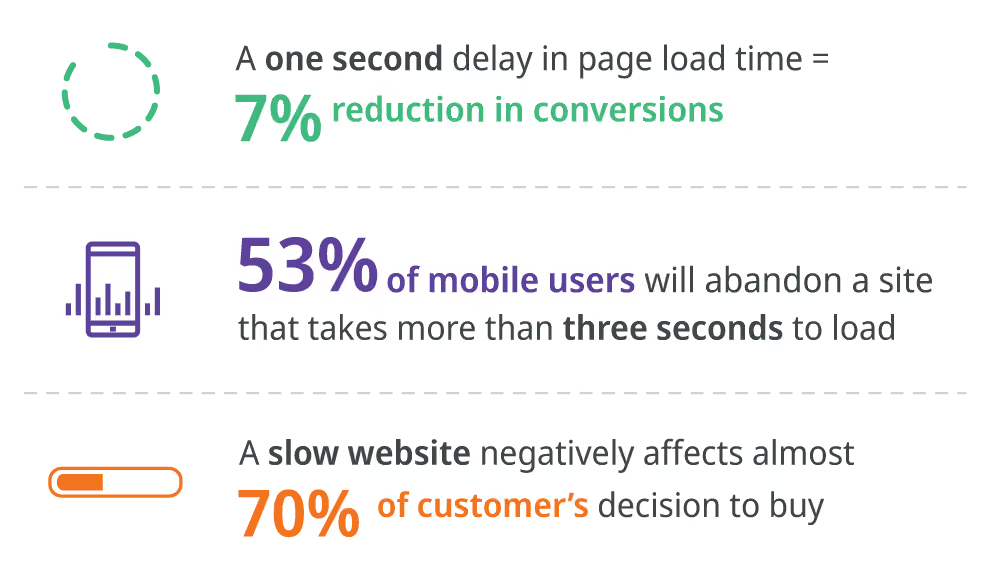
Speed is essential to agility and one of the most critical aspects of cloud retail IT solutions. Without it, even the flashiest e-commerce site will fail:
Speed is also important on the backend. For example, early in their cloud journey, many retailers chose monolithic architecture for their ecommerce site, the practice of designing and developing an entire application in a single unit (frontend, API, services, load balancer, database, etc.).
This model made sense because it offered all the e-commerce functionalities that retailers needed in one unit or product. Unfortunately, monolithic applications are not very agile. Instead, they are tightly coupled, meaning that if something goes wrong with a specific function, the entire application could crash, incurring costly downtime. Furthermore, adding new features is time-consuming and complicated, impacting scalability.
As a result, many retailers are moving to microservices architecture, a collection of separate executable files that can be maintained and replaced independently without redeploying the entire application.
For example, an e-commerce application will have functionalities such as listing products, adding products to carts, checking out an order, and making payments. With microservices, each of these functions is developed and deployed independently and integrated through an API gateway for a fully modular and composable technology stack.
Retailers can change prices, products, and workflows on the fly without disrupting business. When (not if) the market changes, the retailer can adjust its infrastructure in real time to ensure it stays in tune with consumer behavior.
A microservices architecture relies on system and data integration to connect all the moving parts.
Enterprise integration platform-as-a-service (iPaaS) technology, in particular, supports the flexibility of a composable technology stack, where legacy applications are replaced and/or connected with cloud-based applications.
With streamlined data flows from retail information systems, the company benefits from accurate analytics, essential in retail forecasting to predict inventory and demand. These agile connections allow the company to easily adjust its infrastructure to leverage new innovations without incurring downtime to execute the work.
Digibee has partnered with many successful retailers to implement systems and data integration. A good example is Payless, an international self-service footwear retailer. By implementing Digibee’s eiPaaS, the company was able to integrate a secure e-commerce platform into over 200 stores across 15 countries in less than 30 days, with zero downtime.
With DigiBee, Payless has optimized its agility, maintaining business as usual even during peak sales during high-volume events like Black Friday.
A healthy future depends on retailers’ ability to deliver amazing digital experiences to their customers. To achieve these results, companies must quickly embrace innovations as they emerge, or risk falling behind.
A composable or microservices architecture plays a critical role in these outcomes, allowing the organization to easily replace any component with something better. With the support of eiPaaS technology, retailers can rapidly evolve their businesses.
While this capability has been critical during the pandemic, it also protects businesses from disruption in the future by allowing retailers to accommodate for what’s coming. And there’s a lot to accommodate. While some trends are already underway, others are just around the corner:
Today, online shopping is a critical capability for any retailer, with success depending on the business’s agility and resilience in the face of change. Retailers who are able to keep up with and even anticipate what comes next will be the first movers, securing and growing their market share.
Digibee’s enterprise iPaaS technology enables a composable cloud-based infrastructure, leveling the playing field so retailers of all sizes can deliver a modern shopping experience while amplifying their voice and brand in the cloud. Contact us to learn more or book a demo.
– A one second delay in page load time = a 7% reduction in conversions
53% mobile users will abandon a website that takes more than three seconds to load
– A slow website negatively affects the purchasing decision for almost 70% of customers
Rodrigo cofounded Digibee based on the principles of simplicity, agility and strong human connections — with the goal of freeing less technically savvy customers from their reliance on developers for more rapid, cost-effective digital transformations. After receiving a Bachelor in Computer Science and an MBA, Rodrigo went on to senior roles at CA Technologies and Zup Innovation.
RECOMMENDED POSTS
Discover how logistics integration in healthcare prevents stockouts, improves patient care, and reduces waste with automation and real-time visibility.

What is the best IT solution for retail integrations going forward? Point-to-Point (P2P), Enterprise Service Bus (ESB), or today’s advanced enterprise iPaaS.
Follow the evolution of IT integration from Point-to-Point (P2P) models, to Enterprise Service Bus (ESB) models, and today’s revolutionary iPaaS models. What is an ESB and why is an iPaaS the best choice for enterprise integrations going forward?
Developers now prompt AI tools to build for them. Software companies have built MCP servers that let you work on their platforms straight from an AI chat interface. There’s a better way: starting from a specification.

Is the source of truth held in the code, or in the specification? Why "vibe coding" falls short for enterprise infrastructure and why durable specifications are essential.

An AI engineer explains some of what he had to do to build the Digibee Digital Worker.