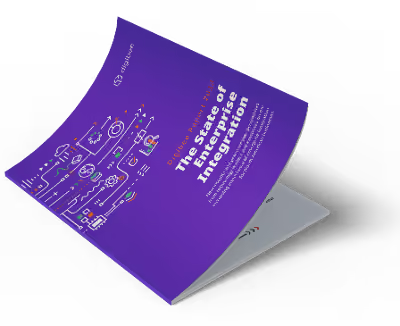
Digibee 2023 State of Enterprise Integration Report: The stories behind the data
Learn the critical role integration plays in digital transformation, based on real-life use cases and data from the Digibee 2023 State of Enterprise Integration Report.
Our second annual survey of the enterprise integration market was published today, revealing some intriguing insights and generating much discussion.
As I reviewed the survey results, I was struck by one constant. Most organizations now consider integration a core requirement for their digital transformation initiatives. In fact, along with cloud migration (a critical enabler in most modernization projects), digital transformation is the top integration objective in the survey, with nearly 30% of respondents ranking it as number one.
This is a surprising result, especially when you consider that just a few years ago, most companies were still on the fence about implementing iPaaS technology.
Inspiration through Integration
My team and I have frequent discussions with many C-suite, IT, and AppDev leaders. During these conversations, we’ve discovered that many have at least one digital transformation project underway—but most have multiple. While most of these projects are relatively straightforward, the underlying motivation for some has been truly inspiring.
So instead of writing a blog post about the Digibee Integration Status Report 2023 Based on the findings, we would like to share some of the inspiring and unique stories behind digital transformation and the numerous reasons why people implement iPaaS to improve their businesses.
Helping people who need help
Objective of digital transformation: Ensure all employees have access to the systems and data needed to support people in need.
Recently, one of our team members spoke with the CIO of a county with a population of several million people. The county emphasizes innovation as a means of providing high-quality support to the people it serves, while prioritizing respect and integrity in all its interactions.
For example, if a person with mental health or housing issues needs assistance, the county wants to ensure that the employee is able to provide the full range of services available to the individual. This may include access to medical or psychological support, shelter, clothing, food, prepaid cell phones, and other necessities.
Unfortunately, this is no simple task. Hampered by standalone legacy applications, third-party systems from other agencies (judicial, medical, etc.), and siloed data, most city employees are only able to access a subset of the data they need to deliver a full service experience. Instead, they must navigate an infrastructure that is patched together with custom coding or no coding at all—often requiring manual, time-consuming paperwork.
Recognizing how the system was failing, the organization’s leaders decided to integrate the county’s entire IT infrastructure, allowing any employee to easily access all the information needed to optimally serve the community.
This was an inspiring discussion. While the newly connected infrastructure also provides significant time and cost efficiencies and a host of other business benefits, it was clear that the real motivation was to help people—public employees and county residents—in their time of need.
Empowering people to be service champions
Objective of digital transformation: Give employees the data they need to work independently, delivering great customer experiences the first time, every time.
Our team also engaged with a leader from an East Coast grocery chain that is currently expanding. The grocery store is known for its unique stores and its unwavering focus on delivering an excellent customer experience (CX).
Recognizing that the best people to optimize CX are those who interact directly with customers, the company embarks on a digital transformation project. Eschewing a formal chain of command management model, the initiative empowers employees to do the things they believe they need to do, in the moment, to help customers.
This requires integrating applications and data across a complex infrastructure comprised of over 100 different systems, from mainframe to modern. The goal of the project is to create a composable and connected infrastructure – essentially a hub, where data is easily shared internally without moving it.
The new model negates the need to actively handle data, such as extract, transform, load (ETL) and other bulk data transactions that take time while increasing security risks and the potential for human error. Instead, the supermarket will have greater visibility and access to real-time data across multiple systems.
Of course, the new system will provide the organization with a range of benefits beyond an optimized CX, including real-time data analytics to help guide day-to-day business decisions. But it was clear from the discussion that the most important aspect of the project – the North Star – is supporting and empowering the people who work there to deliver the best customer experience every time.
The next big idea
The stories of digital transformation are endless and will continue to evolve, inspired by human creativity and enabled by technology. Based on survey feedback from industry leaders, integration has become a critical component to achieving our big ideas, today and in the future.
Download a copyDigibee’s 2023 State of Enterprise Integration report to get the full story, including how iPaaS is helping organizations achieve their digital transformation initiatives.
If you have an integration story you’d like to share or you’re in the midst of a project you’d like to discuss, please contact us. If you’re interested in more information about Digibee, book a demo.
Rodrigo cofounded Digibee based on the principles of simplicity, agility and strong human connections — with the goal of freeing less technically savvy customers from their reliance on developers for more rapid, cost-effective digital transformations. After receiving a Bachelor in Computer Science and an MBA, Rodrigo went on to senior roles at CA Technologies and Zup Innovation.
RECOMMENDED POSTS
Systems & API Integration
Digibee’s iPaaS: Changing the Way the World Does Integrations
Learn how Digibee’s unique iPaaS solution can support your crucial digital transformation and cloud migration initiatives.
Founder and president of digital transformation analytics firm Intellyx, Jason Bloomberg examines three myths of modern integration in this September 2021 feature.
Developers now prompt AI tools to build for them. Software companies have built MCP servers that let you work on their platforms straight from an AI chat interface. There’s a better way: starting from a specification.
Is the source of truth held in the code, or in the specification? Why "vibe coding" falls short for enterprise infrastructure and why durable specifications are essential.