iPaaS for fintech: What it is and its advantages.
iPaaS for fintech allows you to integrate financial systems, automate workflows, and ensure operational reliability. See how it works and its benefits.

PUBLISHED
January 1, 2022
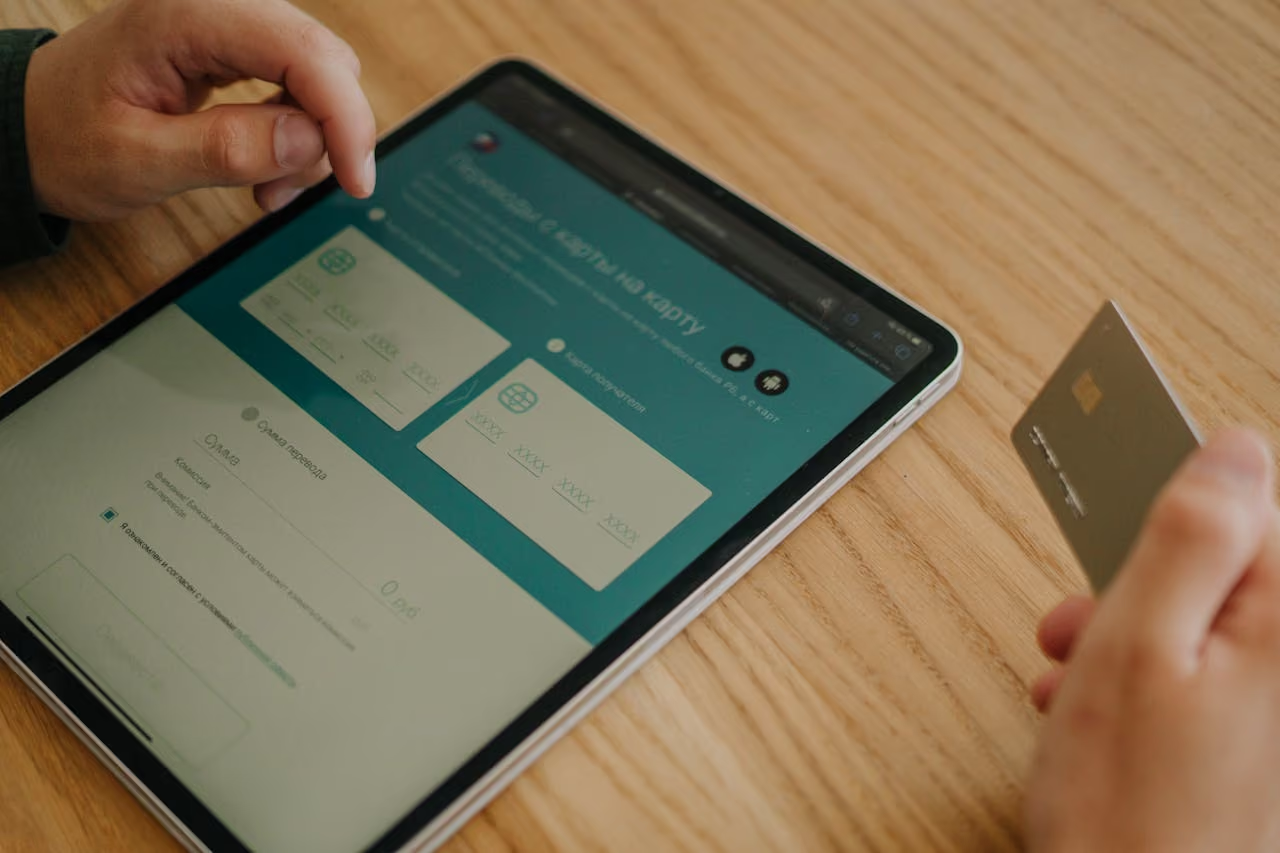
iPaaS for fintech allows you to integrate financial systems, automate workflows, and ensure operational reliability. See how it works and its benefits.
iPaaS for fintech is a cloud-based integration platform used to connect critical systems, APIs, data, and processes within the financial ecosystem with greater governance, security, and scalability. In practice, it helps fintechs integrate Open Finance, digital onboarding, risk analysis, payments, and legacy systems without transforming the architecture into a fragile mesh of difficult-to-maintain connections.
Fintechs operate in an environment where speed, regulatory security, and integration capabilities go hand in hand. It's not enough to launch a product quickly. It's necessary to connect banking APIs, risk engines, KYC solutions, payment gateways, internal systems, and external partners with operational consistency. When this integration is not well-structured, the result is usually increased complexity, more rework, less visibility into critical flows, and greater exposure to risk.
It is in this context that iPaaS gains importance. Instead of relying on point-to-point integrations between financial systems, the fintech company now has a more organized layer to connect applications, transform data, orchestrate flows, and monitor execution with greater control.
In the financial sector, this has even greater significance because integration is not just about connectivity. It underpins customer experience, compliance, operational efficiency, and the ability to launch new services with predictability.
iPaaS for fintech is an integration platform as a service tailored to scenarios where financial systems need to operate together securely, with traceability and scalability. In practice, it connects banking APIs, SaaS applications, internal platforms, databases, compliance tools, and legacy systems into a more governable framework.
Its operation combines connectors, data transformation, triggers, flow orchestration, and observability. This allows, for example, the integration of steps such as registration validation, credit analysis, bureau queries, payment authorization, and internal system updates without relying on multiple isolated developments.
In fintech, this model is especially relevant because many flows need to happen in real time or with low latency, while respecting business rules, security policies, and regulatory requirements. This is what transforms iPaaS into an architectural foundation, and not just an automation tool.
The first advantage lies in agility. Fintechs need to incorporate partners, launch services, and adapt digital journeys quickly. iPaaS helps reduce the time required to connect banking APIs, PSPs, credit bureaus, and operational platforms, accelerating the onboarding of new flows and products.
Another important advantage lies in governance and compliance. In a regulated environment, integration needs to offer traceability, logs, data security, and greater control over how information flows between systems. This strengthens compliance and reduces vulnerabilities in sensitive processes.
There is also a clear gain in scalability. As transactional volume grows, integration needs to keep pace without becoming a bottleneck. iPaaS helps create this elasticity, reducing reliance on fragile structures and improving visibility into operations.
iPaaS makes a lot of sense in workflows that rely on multiple systems working together. This includes integration with Open Banking and Open Finance, connection between digital onboarding and KYC tools, automation of credit journeys, integration between payment methods and back-office, as well as synchronization with risk and scoring platforms.
These cases show that iPaaS doesn't just solve a technical problem. It helps organize financial operations so that data flows more coherently between areas, partners, and products. This improves the customer experience, reduces operational friction, and strengthens the ability to respond quickly to market demands.
In rapidly growing fintech companies, this role becomes even more critical. The greater the number of integrations, the greater the need for a reliable foundation to support controlled growth.
The adoption of iPaaS in fintechs requires attention to criteria that go beyond ease of integration. End-to-end security, latency, observability, high availability, support for regulatory requirements, and the ability to operate in production are central elements. Not every platform responds well to the demands of a financial environment.
It is also important to assess how the platform handles legacy systems, large transaction volumes, strong authentication, messaging, and continuous monitoring. In financial institutions, integration cannot be treated as an accessory feature. It needs to be reliable, traceable, and prepared to support critical processes without loss of architectural control.
At Digibee, this point is central. The challenge is not just to integrate quickly, but to integrate with sufficient maturity to sustain innovation, governance, and scale within a demanding financial ecosystem.
It is a cloud integration platform used to connect systems, APIs, data, and processes in the financial environment with greater security and scalability.
Because they operate with multiple partners, APIs, and critical workflows, and need to integrate all of this with agility, governance, and compliance.
Yes. It helps connect APIs, consents, financial data, and operational flows with more consistency and control.
It can be, provided the platform offers encryption, strong authentication, observability, data segregation, and support for regulatory requirements.
Onboarding, credit, payments, compliance, customer service, back-office, and integrations with external partners.
It is important to assess security, observability, scalability, latency, connectivity with financial systems, and adherence to regulatory requirements.
Talking about iPaaS for fintech means talking about the ability to integrate an increasingly distributed financial ecosystem with greater operational maturity. Fintechs depend on banking APIs, onboarding journeys, risk engines, payment partners, compliance platforms, and internal systems working together in real time. When this network grows without a well-structured integration layer, silos, rework, low traceability, and greater difficulty in sustaining innovation securely emerge.
At Digibee, this issue is treated as part of the enterprise architecture, not as an isolated connectivity problem. The central point is not just connecting systems. It's about creating a reliable foundation to orchestrate critical flows, reduce complexity, increase operational visibility, and sustain technological evolution responsibly. In fintechs, this has direct implications for customer experience, operational efficiency, regulatory compliance, and the ability to launch new services.
This vision is especially important in an industry where speed and control need to coexist. Integration needs to be secure, observable, scalable, and production-ready. It needs to connect cloud, APIs, external partners, and often legacy systems without turning the architecture into a set of fragile exceptions. It is at this point that iPaaS ceases to be merely a technical choice and becomes a decision of operational maturity.
In practical terms, iPaaS helps fintechs reduce friction between systems, accelerate innovation, and grow with greater predictability. This is what makes it a strategic foundation for financial organizations that need to modernize their operations without losing governance.
Rodrigo cofounded Digibee based on the principles of simplicity, agility and strong human connections — with the goal of freeing less technically savvy customers from their reliance on developers for more rapid, cost-effective digital transformations. After receiving a Bachelor in Computer Science and an MBA, Rodrigo went on to senior roles at CA Technologies and Zup Innovation.
RECOMMENDED POSTS
Discover how logistics integration in healthcare prevents stockouts, improves patient care, and reduces waste with automation and real-time visibility.

What is the best IT solution for retail integrations going forward? Point-to-Point (P2P), Enterprise Service Bus (ESB), or today’s advanced enterprise iPaaS.
Follow the evolution of IT integration from Point-to-Point (P2P) models, to Enterprise Service Bus (ESB) models, and today’s revolutionary iPaaS models. What is an ESB and why is an iPaaS the best choice for enterprise integrations going forward?
Developers now prompt AI tools to build for them. Software companies have built MCP servers that let you work on their platforms straight from an AI chat interface. There’s a better way: starting from a specification.

Is the source of truth held in the code, or in the specification? Why "vibe coding" falls short for enterprise infrastructure and why durable specifications are essential.

An AI engineer explains some of what he had to do to build the Digibee Digital Worker.