Improving and facilitating efficiency in Industry through integration
Discover the Industry’s top three integration goals for 2023 in Digibee’s 2nd annual survey and learn how Digibee can meet your integration needs.

PUBLISHED
June 28, 2023

Discover the Industry’s top three integration goals for 2023 in Digibee’s 2nd annual survey and learn how Digibee can meet your integration needs.
The manufacturing sector has long been a leader in innovation. The industrial revolution over a century ago centered on the adoption of mechanical advances to produce items at speeds and volumes that would have been previously unimaginable.
Henry Ford’s concept of the assembly line in the 1910’s, Toyota’s Kanban methodology introduced in the 1940’s and Kaizen in the 1980’s, and Motorola’s development of Six Sigma in the 1990’s are additional revolutionary principles established by manufacturing, then adopted by many other industries.
In 2023, manufacturing challenges center upon computer integrated manufacturing and data proliferation.
Earlier this year we conducted the Digibee 2023 State of Enterprise Integration survey, bringing together insights from over a thousand CTOs, CIOs, systems architects and web developers from key sectors such as Industry, Finance and Retail.
Several broad themes emerged, representing the goals and challenges experienced by all sectors, while other areas revealed more specific nuances. In this post, we explore the insights gained specifically from the Industry sector and the trends revealed by the report.
>> Book a personalized demo with our team of experts and see how Digibee’s iPaaS will bring efficiency to your business.
Not unlike the industrial revolution, modern advances in technology have spurred huge leaps in innovation, forcing manufacturers to adapt or risk losing their competitive advantage. New industry trends include servitization, hyper-automation, and sustainability, with all companies striving to become more data-driven due to rapid adoption of connected devices.
The Digibee State of Enterprise Integration Report findings indicate the adoption of these new trends and related pressures are critical drivers behind enterprise integration within the manufacturing sector:
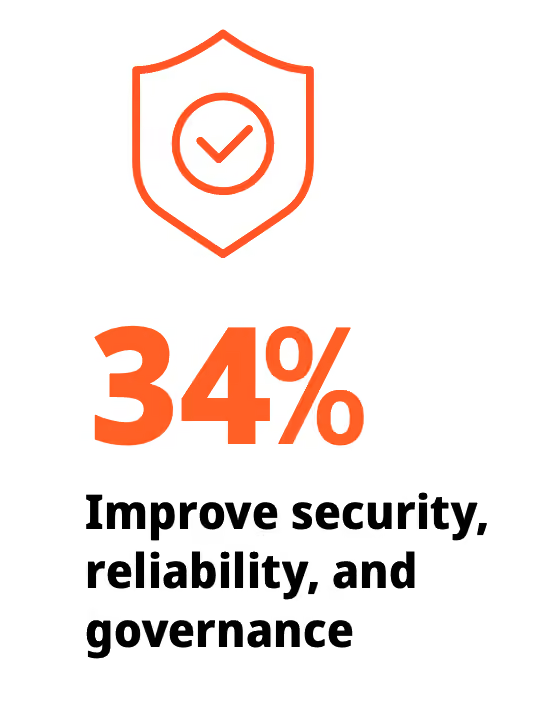
When survey respondents were asked about goals for integration, Improving Security, Reliability, and Governance ranked 4th across all industries for integration goals, but by contrast it represents the top priority for the manufacturing sector in 2023. The root cause of this concern is the vast array of valuable private data manufacturing systems now handle –everything from the Intellectual Property behind the products being made to the personal information of the employees –requiring many points of access to be secured within Integrated manufacturing solutions.
Businesses are no longer stand-alone operations; they are components of critical infrastructures and supply chains, which significantly increases their exposure to risks.
Forbes Technology Council
While security concerns have drastically changed for manufacturing technology in recent years, the pursuit of higher reliability, efficiency, and predictability within manufacturing goes back as far as the industry itself.
Once an item is manufactured, there is no “undo button” that can retrieve the valuable raw materials used. That’s why reliability in Industry control systems will always be a priority, especially when compared to industries that don’t produce physical goods. Integration is essential to ensuring reliability, as it enables real-time visibility and monitoring of data, ensuring consistency and accuracy across all stages of manufacturing execution systems.
Improvements in governance are built upon insights gained from the integration of different systems within the manufacturing management system. With well-integrated systems, an overview of the internal workings is monitored in real-time to meet standards, and to reduce anomalies or mistakes that jeopardize quality, security, compliance, and safety.
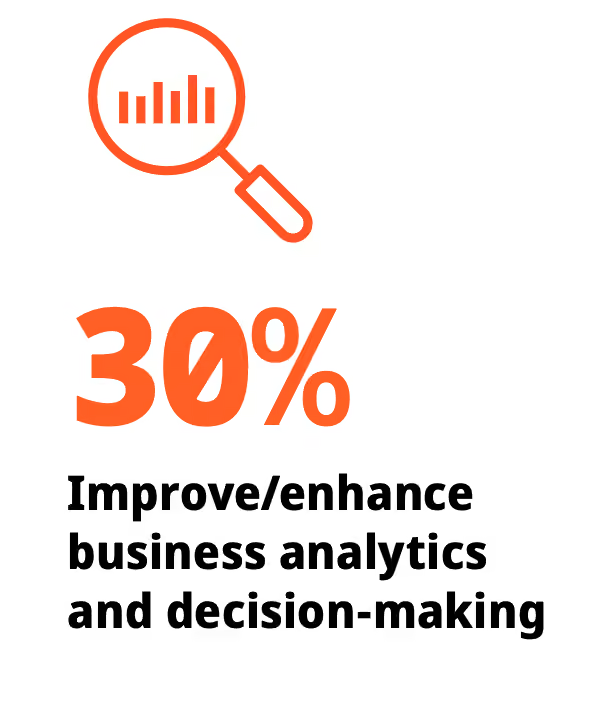
Better governance results in higher quality data, which in turn supports business analytics and decision-making.
With retailers prioritizing improved time to market in the survey, increased pressure will be placed on some manufacturers to produce new products faster.
Retail demand forecast draws upon business analytics to uncover buying patterns to predict future sales. To keep ahead of the curve, a similar integrated infrastructure must be adopted by manufacturers.
Enhanced business analytics help inform demand, supporting supply chain management and just-in-time inventory practices. These are top of mind concerns, with many manufacturers still recovering from the crippling supply-chain issues experienced during the pandemic.
Enterprise integration supports the unification of data from different applications across the operation, streamlining data access and analytics. Manufacturers are leveraging these valuable stores of data to support and help guide the business.
– Digibee
EI Report 2023 – The State of Enterprise Integration for Manufacturingng
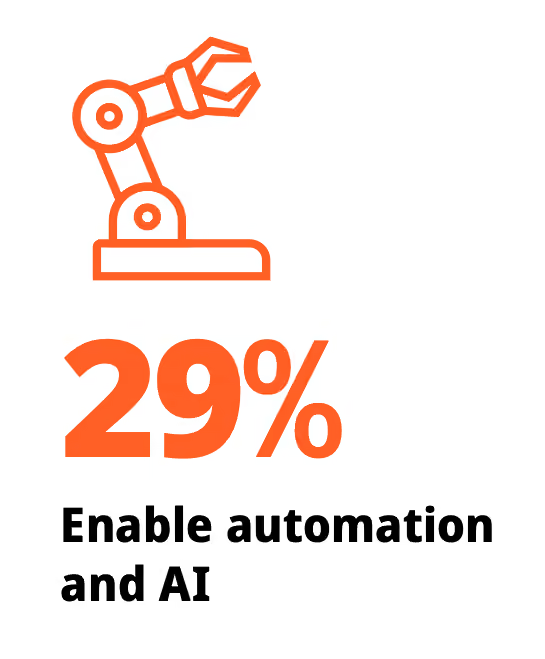
Just as governance requirements rely on business analytics, decision-making is increasingly reliant on automation and AI within integrated manufacturing systems.
Better data integration in manufacturing makes it easier to manage and organize larger volumes of information. However, these large volumes of data represent a barrier for less technologically advanced companies, which still rely on legacy systems and manual workflows – a scenario that affects 74% of manufacturers .
AI allows manufacturers to extract significant value from the data generated, recognizing patterns within unstructured data and creating models for future outcomes.
The possibilities go far beyond the obvious use case of forecasting future sales and extracting data from manufacturing software systems. Innovative companies have employed tools based exclusively on visual monitoring, such as ŠKODA's Magic Eye project, which identifies and predicts undesirable conditions in its EHB3 conveyor.
AI also enables a host of innovative manufacturing capabilities, including automation.
Computer integrated manufacturing provides the solid digital foundation needed to adapt to the industry trends and pressures of the modern world. Streamlining data storage and access with Digibee gets the most out of your manufacturing system, whether the challenges you face are at the executive offices or on the factory floor.
Digibee’s intuitive monitoring systems and platform security features allow you to safely connect and integrate with partner and customer systems, for a real-time operation and increased efficiencies.
Download the Digibee 2023 State of Enterprise Integration for Manufacturing report and gain in-depth insights into all the data. Understand how your peers are progressing and analyze year-over-year trends and observations to guide your integration strategy.
Rodrigo cofounded Digibee based on the principles of simplicity, agility and strong human connections — with the goal of freeing less technically savvy customers from their reliance on developers for more rapid, cost-effective digital transformations. After receiving a Bachelor in Computer Science and an MBA, Rodrigo went on to senior roles at CA Technologies and Zup Innovation.
RECOMMENDED POSTS
Is the source of truth held in the code, or in the specification? Why "vibe coding" falls short for enterprise infrastructure and why durable specifications are essential.


Integrating healthcare systems goes beyond connecting tools. It is about creating a functional ecosystem that allows the flow of information between different platforms and facilitates data-driven decision-making.

If you’re struggling with siloed operations and data, a business systems integration can help. Learn more about the benefits and where to start.
Developers now prompt AI tools to build for them. Software companies have built MCP servers that let you work on their platforms straight from an AI chat interface. There’s a better way: starting from a specification.
Is the source of truth held in the code, or in the specification? Why "vibe coding" falls short for enterprise infrastructure and why durable specifications are essential.
An AI engineer explains some of what he had to do to build the Digibee Digital Worker.