What is Cloud Integration? Definition, Examples, and Benefits
Realize an efficient, scalable cloud integration project with Digibee’s iPaaS to digitally transform and future-proof your business.

PUBLISHED
December 7, 2023

Realize an efficient, scalable cloud integration project with Digibee’s iPaaS to digitally transform and future-proof your business.
Cloud integration is the seamless connection and coordination of diverse software applications, data, and services across multiple cloud platforms, enhancing efficiency and facilitating digital transformation within an organization.
Click and Learn More
It's a crucial part of scalability: connecting a complex ecosystem of business applications and data in a hybrid or multi-cloud environment. Companies implement cloud integration projects to eliminate silos, optimize workflows and business processes, and connect difficult on-premises applications with more modern solutions.
A cloud integration initiative can refer to both application integration and facilitating the flow of real-time data across legacy and cloud-based systems. Concepts related to cloud integration include cloud orchestration, cloud data integration, hybrid integration, and iPaaS.
The characteristics of a successful cloud integration project are: interoperability, visibility, scalability, and security. While some companies struggle to achieve these goals, others are already leveraging modern integration platforms to connect all their applications, keep data secure, and allow developers to focus on high-value work.
>> Book a personalized demo with our team of experts and see how Digibee’s iPaaS will bring efficiency to your business.
Enterprise cloud integration is the process of connecting various legacy and modern applications, data sources, and services into a single hybrid or cloud-based ecosystem. It's typically the work of integration architects and engineers who help develop a... digital transformation strategySelect an integration platform and oversee the process of migrating and connecting data to the cloud.
While some cloud integrations connect only cloud applications, most enterprise initiatives involve a combination of legacy applications, on-premises systems, SaaS solutions, and dozens of different microservices and business tools. IT teams must strategically select the technology to be integrated, consider how they will protect sensitive data and comply with regulations, and decide how they will manage their integration processes as business needs evolve. A successful cloud integration allows businesses to... transform your architectureStreamline operations and act based on real-time data, protecting confidential information and keeping costs manageable.
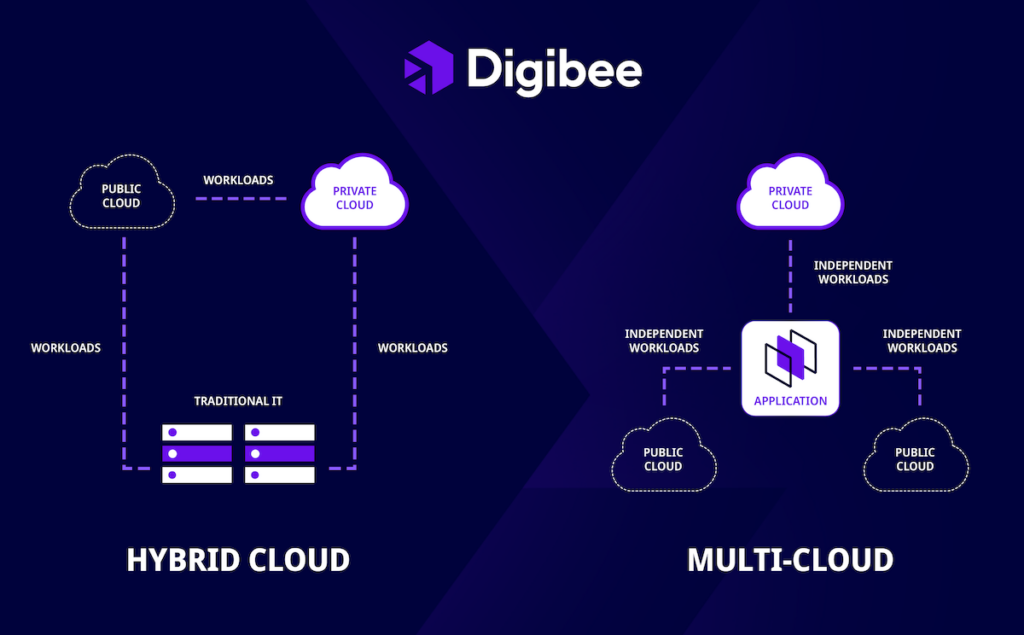
The term "cloud integration" can refer to various combinations of deployments and solutions. Some companies choose one... hybrid implementationt Some systems keep confidential data on-premises but allow systems to interact with cloud applications for streamlined workflows. Others implement entirely in the cloud, using APIs and connectors to integrate applications and analyze data in real time within modern BI tools.
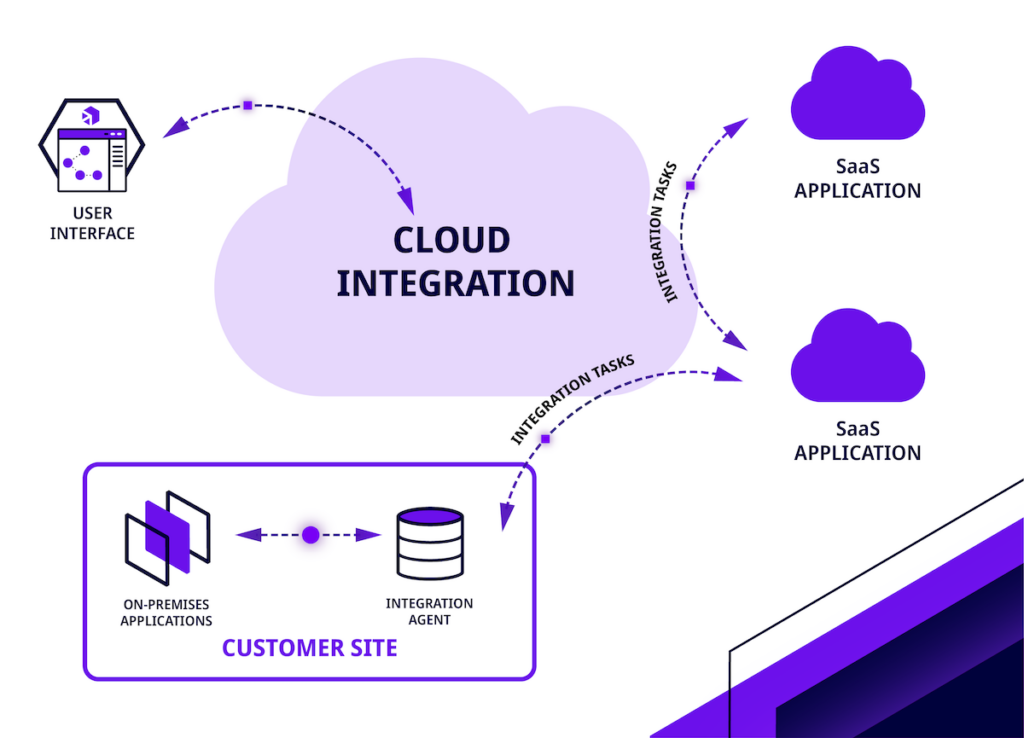
Cloud integrations generally fall into two types:
The first, application integration, is the process of connecting applications through native integrations, reusable components such as connectors and accelerators, or APIs. These methods vary depending on the company's architectural choices and how the applications need to interact. Application integration allows an action in one application to trigger a workflow in another, enabling automation, business application connectivity, and operational efficiency.
The second aspect of cloud integration is data integration, or the process of connecting multiple sources and enabling the real-time flow of data across the organization. Companies can collect data from integrated applications, funnel it into cloud-based tools and data warehouses, and analyze it on BI platforms. This helps companies improve data management, enhance consistency by eliminating data silos, and empower teams to make data-driven decisions.
Since cloud integration involves multiple environments, tools, and data sources, and is critical to the success of each team, it's important for developers, data specialists, and integration architects to collaborate to align every dimension of a cloud integration initiative.
A well-implemented cloud integration brings together complex and siloed systems into an interconnected ecosystem. Companies that successfully integrate legacy solutions and connect data across all their tools gain complete business visibility, optimize costs, and scale rapidly.
Cloud integrations connect and standardize data from legacy systems and newer cloud applications. With a single source of truth, data teams can perform deep analysis, create dashboards and reports in a BI tool, or build self-service products that non-analysts can use to get answers quickly. When everyone works with the same data, and not in data silos, decisions are made quickly and confidently.
When applications are integrated into the cloud and data flows freely without overloading resources, many manual processes can be eliminated. Developers can use APIs to quickly connect new tools and experiment with automation, creating new scalable workflows. A single enterprise-wide workflow improvement, such as automating invoice creation based on a purchase order in an ERP, can cut costs almost instantly and improve cash flow.
Cloud integration not only reduces costs by enabling automation, but also reduces IT overhead. Instead of maintaining legacy integration flows and increasing the backlog with each adjustment, engineers can modernize their architecture and free up time for core development projects. See an example here. Bauducco case study.
Many companies develop cloud integrations on a modern, containerized infrastructure that automatically scales as capacity needs change. This approach eliminates the need to run time-consuming batch processes, mitigates the latency associated with legacy databases, and circumvents rate cap restrictions on application functionality.
Current cloud integrations are built using a modular and combinable architecture. This facilitates the addition or replacement of tools, rapid response to stakeholder requests for dashboards, reports, and automations, and ensures that datasets and systems remain secure and compliant.
Integrating applications and data in the cloud gives organizations a competitive advantage. They can better serve customers with high-quality support, adopt the latest AI and automation tools, and rapidly implement products and services in response to market demands.
While some companies attempt to develop an integration solution internally or remain with legacy on-premise applications, such as a legacy iPaaS, these choices can lead to several problems. Cloud integration is not a one-off task, but rather an ongoing initiative that requires oversight to ensure data security, maintain compliance, and promote continuous improvement as technology evolves.
Below are some of the biggest challenges that come with a cloud integration project:
Some cloud integration solutions can take more than a year to fully implement, with tedious training requirements and expensive vendor service add-ons. When starting your digital transformation initiative, look for integration tools that are easy for any developer—not just integration specialists or platform-certified experts—to get started using quickly.
Cloud applications are frequently updated, acquired, replaced, and refactored—changes that are difficult to keep track of if you're managing legacy integration flows with existing on-premises systems. Developers must consider what happens in these scenarios, as well as how they will avoid downtime and performance issues as they update any custom integrations.
Some companies try to build their own solution instead of adopting a platform built for cloud integrations. This approach is not scalable: each integration flow takes a long time to build and maintain, the infrastructure must be managed internally, and each new stakeholder request adds so much to the engineering backlog that it is difficult to achieve ROI.
Cloud integration moves large datasets across multiple platforms. Without adequate security controls, the risk of exposing confidential information or non-compliance with industry or regional regulations increases. Modern cloud integration platforms are built on industry-leading infrastructure and include governance and security controls, preventing you from having to do this yourself, which can result in fines and technical vulnerability.
The most efficient and scalable way to implement a cloud integration project today is with an Integration Platform as a Service, or iPaaS. An iPaaS is a platform that developers use to build and manage integrations in a scalable architecture. It replaces outdated integration options like ESB and includes features such as reusable components, a low-code interface, managed infrastructure, pre-built integrations, and enterprise support.
Unlike some of its predecessors, Digibee’s iPaaS It does not require specialized training or a lengthy implementation. On the contrary, it accelerates digital transformation projects by automating and simplifying the development of workflows needed to connect legacy enterprise solutions and cloud applications within an ecosystem.
Digibee is different in that it is the only integration platform that scales application integration workflows while reducing cost, technical debt, and the burden on development teams. It allows developers to quickly build, test, deploy, govern, and monitor integrations across on-premises systems and cloud environments—they can then use the platform in tandem with API management and ETL tools for full synchronization across the organization.
What makes Digibee the the right business integration platform for your cloud integration initiative?
To successfully drive a cloud integration initiative today, companies must adopt a combinable, modular, and scalable approach to integration architecture. To learn more, download the [resource/tool name]. 2023 State of Enterprise Integration report.
>> Book a personalized demo with our team of experts and see how Digibee’s iPaaS will bring efficiency to your business.
Rodrigo cofounded Digibee based on the principles of simplicity, agility and strong human connections — with the goal of freeing less technically savvy customers from their reliance on developers for more rapid, cost-effective digital transformations. After receiving a Bachelor in Computer Science and an MBA, Rodrigo went on to senior roles at CA Technologies and Zup Innovation.
RECOMMENDED POSTS
An AI engineer explains some of what he had to do to build the Digibee Digital Worker.

AI will not replace deterministic workflows in financial services. It complements them with reasoning and context capabilities where rules alone are not enough.

What differentiates an AI-native platform from an AI-powered one? A platform rebuilt for agents, with specialized workflows and collaboration between people and AI.